













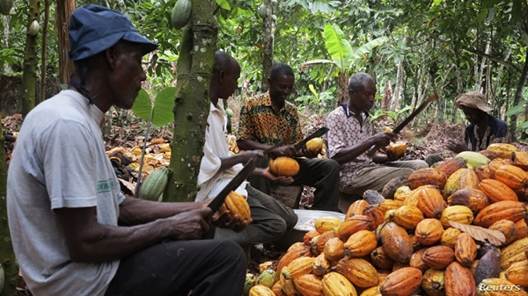

Ghana’s cocoa export revenue nearly doubled in 2025, but the sharp increase has triggered questions over how much of the additional value generated from the commodity reached farmers.
The Institute of Economic Research and Public Policy (IERPP) says the widening gap between Ghana’s cocoa export earnings and the producer price paid to farmers warrants a detailed review of the financial flows across the cocoa value chain.
In a statement signed by its Executive Director, Prof. Isaac Boadi, the Institute said cocoa export earnings rose from US$1.94 billion in 2024 to US$3.86 billion in 2025, representing a 99.2% increase.
The increase coincided with a rise in Ghana’s realised cocoa price—the average international price received per tonne—from US$4,440 to US$5,877.40, equivalent to a 32.4% increase.
In cedi terms, IERPP’s calculations show that the export earnings increased from approximately GH¢28.52 billion in 2024 to GH¢42 billion in 2025, based on Bank of Ghana exchange rates of GH¢14.70 to the US dollar in 2024 and GH¢10.88 in 2025.
That represents an increase of approximately GH¢13.48 billion, or 47.3%, despite the appreciation of the cedi against the dollar.
Revenue distribution under scrutiny
The business think tank said the scale of the increase in cocoa export earnings makes the producer price paid to farmers a key issue in assessing how value is distributed within the sector.
IERPP noted that farmers were being paid GH¢2,500 per bag, arguing that the figure appears low when compared with the movement in realised international cocoa prices.
Using a proportional calculation, the Institute said a 32.4% increase applied to the previous producer price of GH¢3,100 would result in approximately GH¢4,104 per bag.
That would leave a difference of about GH¢1,604 per bag compared with the GH¢2,500 currently cited by the Institute.
Using GH¢3,500 as the previous producer price would produce an adjusted figure of approximately GH¢4,634 per bag, creating a gap of more than GH¢2,100.
IERPP, however, acknowledged that international cocoa prices and export earnings cannot be directly translated into the farmgate price because the cocoa business involves several other costs.
These include financing, transportation, processing, marketing and the operational expenses of the Ghana Cocoa Board (COCOBOD).
COCOBOD earnings add to questions
The Institute said the financial picture requires closer examination following the reported GH¢5.11 billion in COCOBOD earnings contained in the 2025 report of the State Interests and Governance Authority (SIGA).
IERPP is therefore calling for a comprehensive financial breakdown of the cocoa value chain to establish how export revenue is allocated between farmers, COCOBOD and other participants in the sector.
“If cocoa export earnings rose from US$1.94 billion to US$3.86 billion, realised cocoa prices increased by 32.4%, and COCOBOD recorded GH¢5.11 billion in the period under review, why did the cocoa farmer receive only GH¢2,500 per bag?” the Institute queried.
The demand for greater disclosure comes amid the broader importance of cocoa to Ghana’s export earnings and the livelihoods of cocoa-producing households.
IERPP wants Government and COCOBOD to publish details covering total export earnings, international cocoa prices, exchange-rate movements, COCOBOD revenues and expenditure, producer-price calculations, actual payments to farmers and the distribution of value across the cocoa supply chain.
The Institute said such information would help stakeholders understand the relationship between the prices Ghana earns on international markets and the income received by producers at the beginning of the value chain.
“Ghana’s cocoa farmers deserve more than political arguments. They deserve mathematics, and a clear explanation of where the money went,” the statement concluded.
This version keeps the story firmly on export revenue, pricing, margins, cost structure and value-chain distribution, making it more suitable for a business/economy desk.