













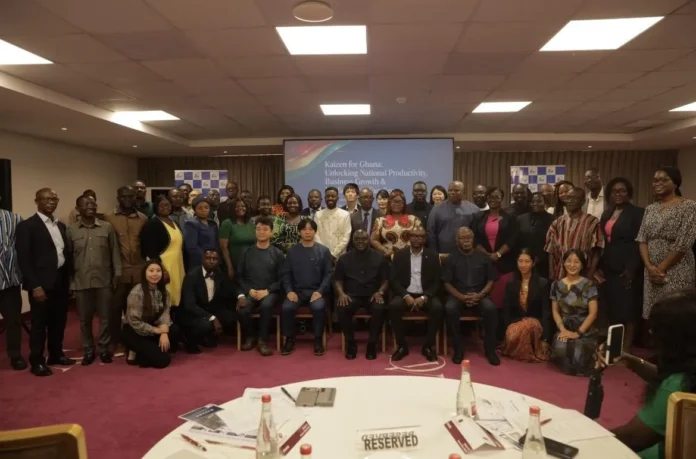

The Japan International Cooperation Agency (JICA) has called on Ghana to adopt Kaizen as a national development philosophy to improve productivity, strengthen institutions and enhance service delivery across both the public and private sectors.
Speaking at the high-level awareness seminar themed “Kaizen for Ghana: Unlocking National Productivity, Business Growth and Public Sector Excellence” held in Accra, JICA Ghana Chief Representative, Takayuki Uchiyama, said Ghana’s development agenda requires more than infrastructure and policy reforms.
“We recognise that structural inefficiencies, bureaucratic delays, weak workplace systems, skills mismatch and value deficits continue to affect productivity and service delivery across sectors,” he noted.
“These challenges cannot be addressed by infrastructure investments and policy reforms alone. Sustainable transformation requires a national mindset shift, one that embeds a culture of continuous improvement, discipline, efficiency and excellence within our institutions and society,” he added.
Mr. Uchiyama explained that Kaizen, a Japanese philosophy based on continuous improvement through small and practical actions, played a critical role in Japan’s post-war economic transformation and global competitiveness.
“Japan’s post-war transformation did not happen by chance. It was driven by a deliberate national commitment to discipline, efficiency, teamwork and continuous improvement; a philosophy globally known as “Kaizen”,” he said.
According to him, the Kaizen philosophy promotes accountability, teamwork, innovation, respect for time and quality service delivery; values, he said, are necessary for Ghana’s sustainable development.
Using Ethiopia as an example, he said through high-level political commitment and national institutionalisation, the country established the Ethiopia Kaizen Excellence Centre and mainstreamed Kaizen within industries, public institutions, technical education and productivity policies. This national approach has contributed to improved industrial performance, stronger work culture and enhanced institutional effectiveness.
He observed that although Ghana’s labour productivity improved by 3.06 percent in 2024, according to the Ghana Statistical Service (GSS), the figure remains below the country’s long-term historical average of 6.06 percent.
“Ghana today stands at a critical point in its development journey. According to the Ghana Statistical Service, labour productivity improved by 3.06 percent in 2024. While this is encouraging progress and a sharp rebound from the previous year, it sits below Ghana’s long-term historical average of 6.06 percent (measured from 1992 to 2024),” he pointed out.
Mr. Uchiyama stated that JICA, UNIDO and the Ethiopia Kaizen Excellence Centre believe the time has come for Ghana to move beyond isolated Kaizen projects toward full national adoption and institutionalisation.
He said Kaizen principles could strongly support Ghana’s reset agenda and complement the government’s 24-Hour Economy initiative under the ASPIRE framework by promoting productive institutions, systems and people.
Mr. Uchiyama further explained that institutionalising Kaizen would help improve accountability in public institutions, strengthen the competitiveness of local industries and SMEs, improve service delivery and build a stronger work ethic among citizens.
He added that national transformation begins with people changing how they work, manage time, solve problems and take responsibility in their workplaces and communities.
Mr. Uchiyama reaffirmed JICA’s commitment to supporting Ghana through partnerships focused on productivity, institutional excellence and human resource development as Ghana and Japan prepare to celebrate 70 years of diplomatic relations in 2027.
“As Ghana and Japan prepare to celebrate 70 years of diplomatic relations in 2027, we are confident that our partnership will continue to grow stronger in promoting innovation, institutional transformation and sustainable development,” he reiterated.
Mr. Uchiyama commended the Government of Ghana, the United Nations Industrial Development Organization and the Ethiopia Kaizen Excellence Centre for partnering with JICA to organise the seminar. He also acknowledged the presence of Chief of Staff Julius Debrah and commended his leadership in Ghana’s transformation efforts.
The Chief of Staff at the Office of the President, Julius Debrah, stated that the government recognises the importance of the Kaizen programme, describing it as a growing global phenomenon focused on increasing productivity while eliminating waste and delays.
According to him, the initiative is helping people become more conscious of their work environment and the impact of their actions on national development and institutional growth.
“On behalf of His Excellency the President, we find the importance of this programme. And Kaizen is not only being adopted in Ghana; gradually, it’s becoming a global phenomenon where people are being made conscious of their surroundings and making sure of what they do to encourage and increase productivity, while at the same time eliminating wastage and delays,” he highlighted.
thebftonline