













By Dr. Felix Dela Klutse
How Ghana’s gold rush is carrying pollution from the goldfields to the coast — and testing the country’s first Marine Protected Area.
Ghana has drawn a line around the sea. But pollution does not stop at the boundary of a protected area. This investigation follows what happens upstream — and asks who ultimately pays when a river carries the cost to the coast.
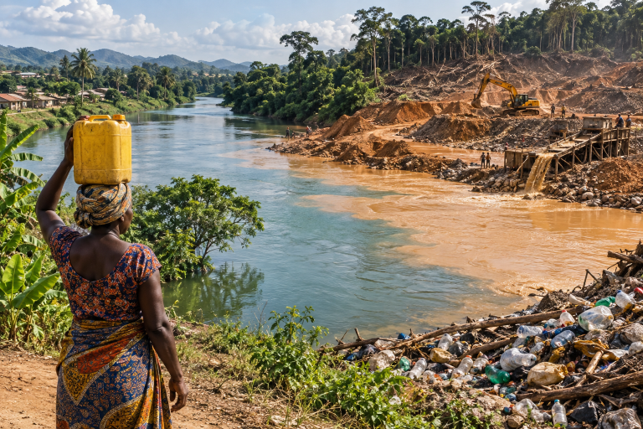
Men and machines tear into the earth in search of gold.
THE RIVER REMEMBERS
The river remembers when its water was clear enough for a child to see the stones beneath the surface. Today, it carries another story—mud, silt and pollution from a gold rush taking place far upstream. Men and machines tear into the earth in search of gold, while rain carries the consequences into streams and rivers, through farms and communities, into wetlands and estuaries, and eventually to the Atlantic.
On 14 April 2025, Ghana declared its first Marine Protected Area in the Greater Cape Three Points enclave, setting aside about 700 square kilometres of coastal waters to protect marine life. But an uncomfortable question remains: what happens when a protected ocean is fed by an unprotected river?
For years, Ghana’s galamsey debate has focused on destroyed forests, farmland, excavators and polluted rivers. However, the river does not stop where the headlines end. What enters the water upstream can travel far beyond the mine, affecting farmers, families, fishermen and marine ecosystems. A fisherman may see fewer fish; a farmer may lose a clean source of water; a conservation programme may struggle to protect an ocean while pollution continues to arrive from inland.
This investigation follows the journey of that pollution—from Ghana’s goldfields to its coast—and asks a deeper question: if Ghana can protect the ocean, why is it proving so difficult to protect the rivers that feed it?
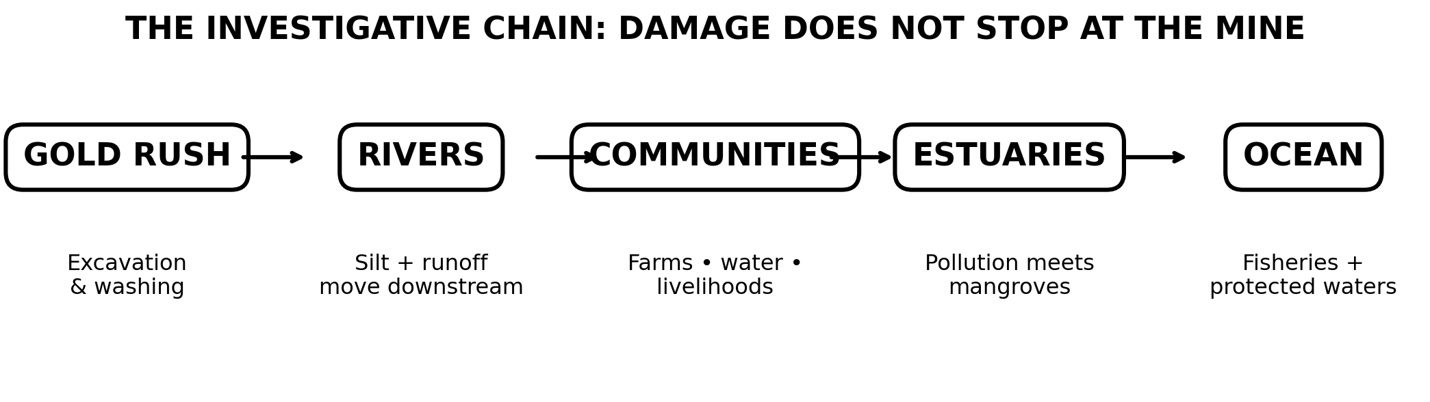
Infographic: the investigation follows the environmental chain from gold extraction to the coast.
THE RIVER TELLS THE STORY
Long before a scientist takes a sample, people living beside a river notice when something has changed. The water looks different. Fish disappear. A once-familiar bank begins to collapse. A stream that supported a community no longer feels safe. Those observations are not laboratory results, but they are often the first warning that a river is under pressure.
Scientific studies from the World Bank have reinforced what communities and environmental groups have warned about for years. A 2022 study of the Pra and Ankobra estuaries found pollution footprints involving microplastics, nutrients and metals. The World Bank researchers calculated pollution load indices of 1.94 for the Pra and 2.71 for the Ankobra, suggesting deterioration of the estuary environments. They found arsenic and iron among the most concerning contaminants and identified signatures associated with illegal artisanal gold mining.
A separate 2022 study assessed water quality and health risks in the same two estuaries. Both were placed in a marginal water-quality category. cloudiness in the water, phosphate, lead, copper and iron contributed to the pollution index. The researchers also found that health-risk indicators calculated for shellfish exceeded recommended thresholds, leading them to warn of potential risks for surrounding coastal populations.
| “The river can carry the consequences of decisions made far upstream into places where the original decision-makers are no longer visible,” the World Bank report has stated. |
What the evidence does show is troubling enough: Ghana’s estuaries are under several pollution pressures, and gold-mining activity is a documented contributor in the Pra and Ankobra systems.
Older research points in the same direction. A study of trace elements in sediments from the Pra and Ankobra estuaries found moderate to significant enrichment of arsenic, silver and copper, with evidence that mining-related tailings and runoff contributed to the contamination. In Ankobra sediments, the probability of exceeding certain sediment-effect levels was substantial for arsenic, chromium and nickel.
The bigger story is not one pollutant. It is the journey. A river can carry the consequences of a decision made far upstream into places where the people who made that decision may never be seen.
That is how environmental externalities work. The person who clears a riverbank may earn from the immediate extraction. The person downstream may inherit the sediment. The water company may inherit the treatment challenge. The farmer may inherit poorer soil or lost irrigation. The fisherman may inherit a stressed estuary. The taxpayer may eventually inherit the restoration bill.
The river does not issue invoices. Governments do. The failure to count those costs accurately can create the illusion that an activity is profitable when part of its true cost has simply been transferred to someone else.
FOLLOW THE GOLD
Gold makes the environmental debate unusually difficult because it is both an economic asset and a source of extraordinary environmental pressure.
Ghana is one of Africa’s major gold producers. Small-scale mining is not a fringe activity. Reuters reported in October 2024 that small-scale mines accounted for roughly 40 percent of the country’s gold output and estimated that 70 to 80 percent of small-scale operations were unlicensed. The report described a sector expanding rapidly as gold prices rose and documented the environmental consequences of unlicensed operations.
At a wildcat site in western Ghana, Business Day Media encountered miners working without professional protective equipment. Jeffery Mensah, a miner, described the risk in stark economic terms: he knew the work was dangerous but needed money to survive. That detail is important because it prevents a simplistic story in which every miner is a villain and every environmentalist is an outsider. Poverty and opportunity are part of the machinery of environmental damage. Yet livelihood cannot be allowed to become an excuse for a system in which the public absorbs the damage.
Illegal mining changes the economic equation because the operator can avoid costs that a compliant business must bear. A legal operator may face licensing requirements, environmental assessments, reclamation obligations, worker-safety standards, taxes and monitoring. An illegal operator can attempt to externalise some of those costs onto land, water and communities.
The more expensive compliance becomes relative to non-compliance, the more attractive the informal route can appear. That helps explain why raids alone have struggled to end the problem. An operation can be shut down today, yet the money behind the equipment, the demand for gold and the need for income can bring the activity back tomorrow.
Business Day investigations revealed that organised crime groups can finance miners in exchange for discounted gold, creating a supply chain in which miners receive capital but become tied to buyers. The report also cited security experts who warned of links between illegal mining, weapons and political or traditional influence in some areas.
But the investigative implication is powerful: follow the money rather than stopping at the pit.
Who paid for the excavator? Who owns it? Who imported it? Who controls the concession? Who buys the gold? Who transports it? Who has the ability to make a mining operation disappear when enforcement arrives? These questions matter because the environmental damage is often the visible end of an invisible chain.
Ghana’s government has recognised the need for a different architecture. In July 2025, the Lands Ministry said Cabinet had endorsed a comprehensive review of the Minerals and Mining Act, 2006 (Act 703), and forwarded the revised bill to Parliament. The ministry said the proposed framework would introduce district mining committees as an entry point for licensing, create a medium-scale mining category, replace the reconnaissance licence with a single prospecting licence capped at five years, limit mining leases to 20 years and make community development agreements mandatory for every lease.
The reforms are significant. But legislation is only as strong as the institutions that implement it. The real test is not how modern the new law sounds. It is whether it changes what happens on the ground.
THE NUMBERS ARE HARD TO IGNORE
On March 24, 2025, Lands and Natural Resources Minister Emmanuel Armah-Kofi Buah presented a grim picture of the environmental damage his ministry said the administration inherited. The ministry reported that nine forest reserves had been under the complete control of illegal miners. It also reported cloudiness in the water levels of between 5,000 and 12,000 NTU in water treated by Ghana Water Company Limited under affected conditions, compared with a 500-NTU permissible point cited by the minister. The ministry estimated the land degraded by illegal mining at the equivalent of 7,500 football fields.
The deeper problem is that Ghana has often measured environmental destruction through isolated events: an excavator seized, a forest patrol conducted, a river described as polluted. The public needs a cumulative account.
How many hectares have been degraded since 2015? How many kilometres of river have been affected? How much has been restored? How many prosecutions followed seizures? How many sites reopened after enforcement operations? How much money has been spent on reclamation? How much has been recovered from offenders? Without those numbers, environmental policy can become a cycle of dramatic announcements followed by uncertain outcomes.
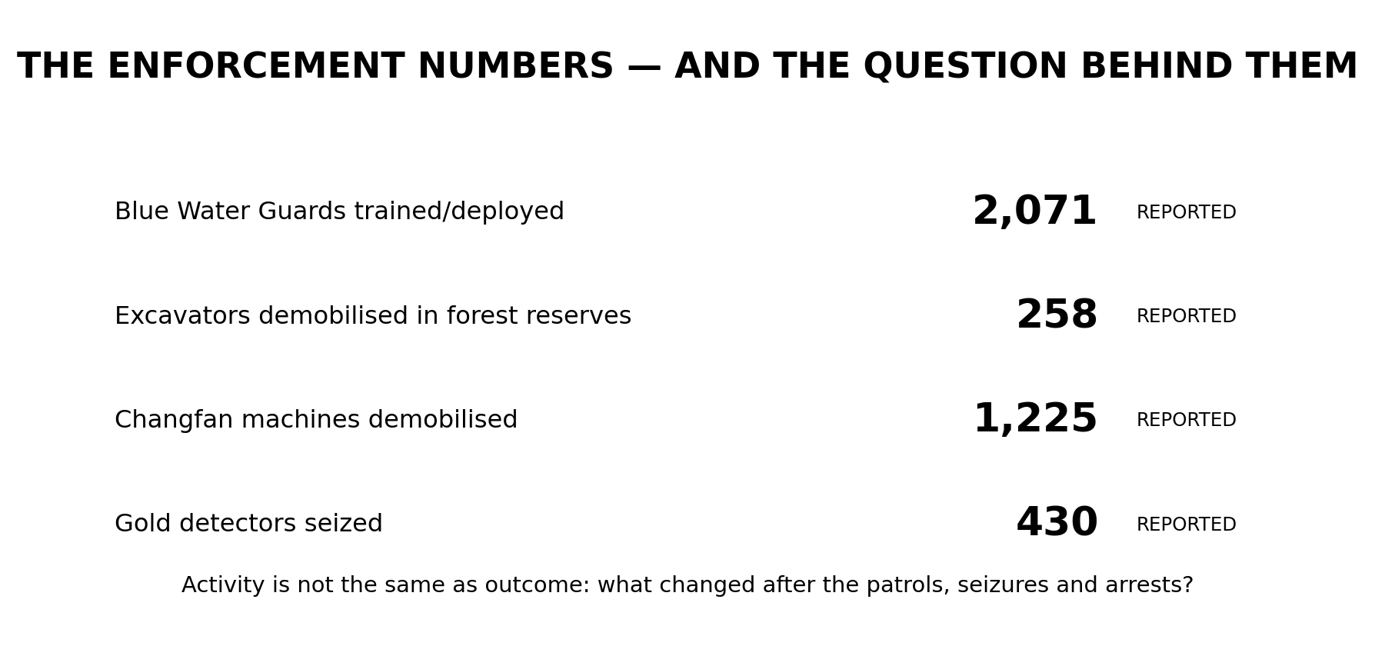
Ghana’s response is now large enough to be measured. The Blue Water Guards programme, introduced in March 2025, had reached 2,071 trained and deployed personnel by May 2025, according to the Lands Ministry. The minister said almost every district where the guards had been deployed had seen improvement in water systems.
WHAT IS IN THE WATER?
Gold processing can involve mercury, and mining areas can also contain arsenic and other metals. The health implications depend on exposure pathway, dose, duration, chemical form and the vulnerability of the people exposed. That complexity is precisely why environmental reporting needs scientists who can interpret data rather than merely supply frightening numbers.
A 2025 study reported by Reuters, involving Pure Earth and Ghana’s Environmental Protection Authority, found concerning mercury and arsenic contamination in several artisanal gold-mining regions. Reuters reported that soil samples in Konongo Zongo averaged 56.4 parts per million of mercury, compared with a 10-ppm threshold cited from World Health Organization guidance, while a peak reading reached 1,342 ppm. Arsenic readings were also reported at extremely elevated levels.
The study was based on a year of sampling of soil, water, crops and fish in six mining regions. That breadth matters because exposure can occur through more than drinking water. People can encounter contaminants through soil, dust, food, skin contact and occupational processes.
Anthony Enimil of Ghana’s Pediatric Society warned of kidney disorders among children from mining areas. The message is clear: contamination can move from the mining site into the food chain.
Mercury is especially difficult because it can change form and move through ecosystems. Fish can accumulate certain mercury compounds, creating exposure for people who eat them. The risk is not identical for every fish species, every water body or every consumer. But the possibility makes monitoring essential.
Ghana has attempted to promote alternatives to mercury-based processing. The government and industry have discussed technologies such as Gold Kacha concentrators and other approaches designed to reduce mercury dependence. The challenge is adoption: a safer technology that miners cannot afford, trust or access will remain a policy document rather than a field solution.
This is another place where the economics of environmental protection matter. If the clean method costs more than the dirty method, and the dirty method is rarely punished, environmental policy is effectively subsidising pollution. The question should therefore be asked in every mining community: What would make safer processing economically rational?
The answer may involve equipment finance, formalised buying systems, access to licensed concessions, training, local processing, transparent gold pricing and enforcement against the actors who profit from illegal supply chains. Environmental protection becomes durable when the cleaner path is not merely morally preferable but economically viable.
THE OTHER RIVER: PLASTIC
Galamsey is visually spectacular. Plastic pollution is ordinary. That is why it can be harder to make people angry about it.
A sachet floating in a gutter does not look like a national economic problem. A bottle lodged beneath a bridge does not look like a climate-policy failure. A plastic bag in a lagoon does not announce the name of the company that produced it. But the waste stream is enormous.
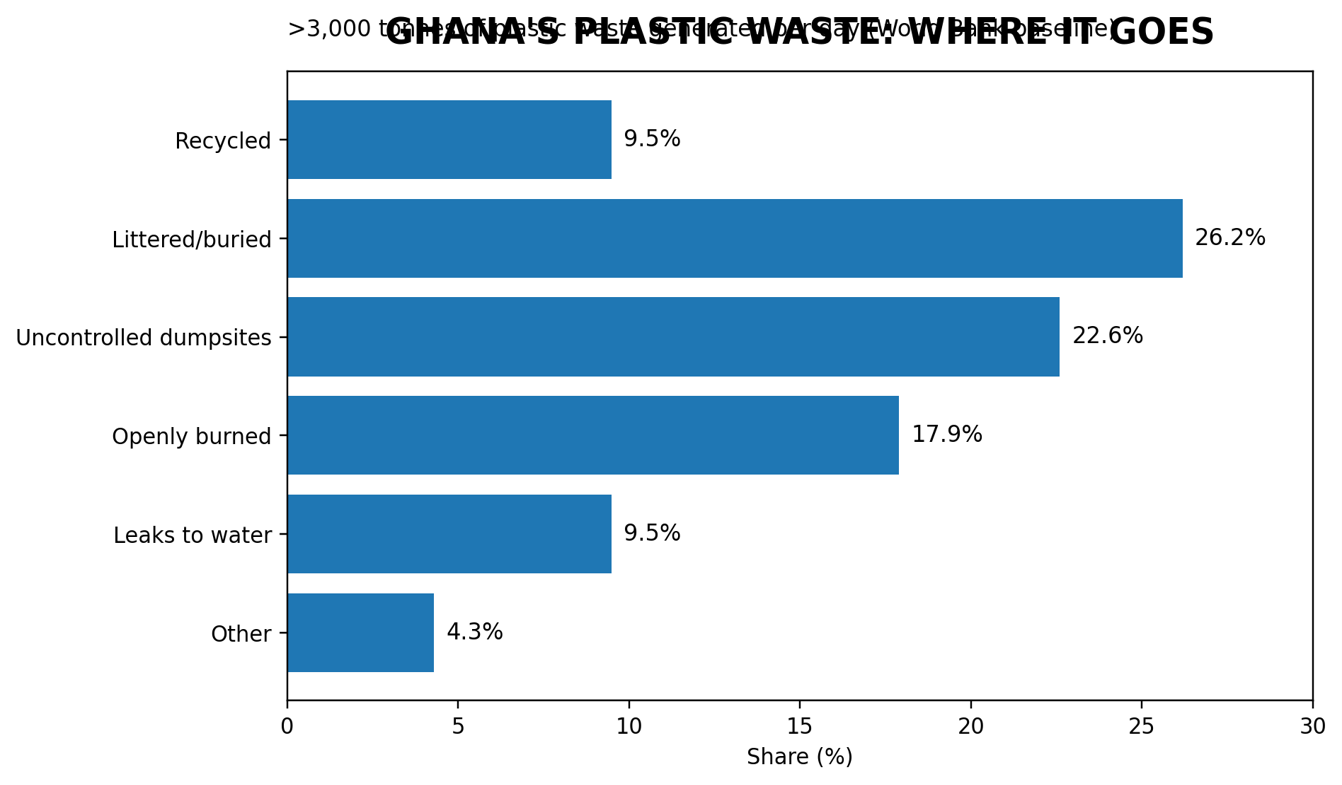
World Bank analysis drawing on Ghana’s 2021 plastics baseline estimates that the country generates more than 3,000 tonnes of plastic waste every day. The same analysis estimates that only about 9.5 percent is recycled. It estimates that 26.2 percent is littered or buried, 22.6 percent goes to uncontrolled dumpsites, 17.9 percent is openly burned and 9.5 percent leaks into water bodies, with the remainder in other categories.
UNDP Ghana has separately cited annual plastic-waste generation of about 840,000 tonnes and recycling of about 9.5 percent. The figures come from different reporting frameworks and years, but they point to the same structural problem: Ghana recycles only a small fraction of its plastic waste. Plastic pollution is therefore not a story about dirty streets. It is a story about missing infrastructure and weak incentives.
Imagine one bottle. A manufacturer makes it. A distributor moves it. A retailer sells it. A consumer drinks from it. Then the bottle enters the waste system. At that point, someone must collect it, sort it, transport it, process it and sell the recovered material—or the environment becomes the default destination. Every step has an economic question.
Who pays the collector? Who owns the collection vehicle? Who buys the sorted material? What price does the recycler receive? Is the material clean enough? Is there a stable buyer? Does the producer contribute to the cost of recovery? Can a household separate its waste without paying extra? These are not environmental side questions. They are the environmental system.
Ghana’s Revised National Plastics Management Policy, adopted in 2019, provides a framework for lifecycle plastics management and a transition toward a circular plastics economy. It emphasises resource recovery, recycling, responsible production and consumption, innovation and coordinated action. That framework is important because it moves responsibility away from the idea that citizens alone can solve the problem through better behaviour.
Behaviour matters. But people behave inside systems. If a consumer wants to recycle but the nearest collection point is inaccessible, the system fails. If a waste picker collects plastic but receives too little to cover transport, the system fails. If a recycler cannot sell the pellets, the system fails. If producers have no meaningful responsibility for post-consumer packaging, the system fails. Policy becomes real only when the incentives line up.
WHEN THE RAINS COME
Flooding is where several environmental failures meet. Climate change does not create every flood in Ghana. Poor drainage, settlement patterns, blocked waterways, land-cover change and inadequate infrastructure all matter. But climate change can intensify the consequences of those weaknesses by altering rainfall patterns, increasing heat stress and raising sea levels.
The World Bank’s Ghana Country Climate and Development Report says flooding affects around 45,000 Ghanaians every year. It also says half of Ghana’s coastline is vulnerable to erosion and flooding associated with sea-level rise. Without prompt action, the report warns, at least one million additional Ghanaians could fall into poverty by 2050, while incomes for the poorest households could fall by up to 40 percent.
Consider a low-lying neighbourhood after heavy rain. Plastic waste reduces the capacity of drains. Silt enters a channel from disturbed land. Wetlands have been filled or narrowed. A river downstream is already carrying sediment. The rain does not need to be historically unprecedented to produce severe consequences; the system has less room to absorb it.
Now move from the city to a farming community. A farmer needs predictable rainfall, healthy soil and water. Deforestation can alter runoff. Mining can destroy farmland. Flooding can wash away topsoil. A drought can arrive in another season. The household does not experience these as ‘climate’, ‘land management’ and ‘mining’ policies. It experiences them as a failed harvest and a higher food bill.
Ghana’s poorest households often have the least ability to insure themselves against environmental risk. They cannot simply move to higher ground. They cannot replace a destroyed farm with another farm. They cannot always buy bottled water when a local source becomes unsafe. They cannot easily absorb a week without income after a flood.
The result is a quiet transfer of risk — from the people making the money to everyone living with the damage. The public pays for drainage. The public pays for water treatment. The public pays for flood relief. The public pays for restoration. The household pays again through lost income, damaged property and health costs. Protecting nature is no longer simply an act of conservation. It is a way of protecting national assets.
WHERE THE RIVER MEETS THE SEA
At the western coast, Ghana’s environmental story completes a circle.
The first Marine Protected Area was declared in the Greater Cape Three Points enclave in April 2025. The protected area covers about 700 square kilometres of coastal waters across 21 communities. Its purpose is to help conserve biodiversity, protect habitats and provide space for marine ecosystems and fish populations to recover.
The legal foundation is Ghana’s Fisheries and Aquaculture Act, 2025. Section 39 provides for the declaration of marine fisheries reserves and restricts activities that disturb natural habitat without permission. The new protected area also fits within Ghana’s international biodiversity commitments, including the global 30-by-30 conservation ambition.
On paper, this is a major environmental step. On the water, the picture is more complicated. Report from Akwidaa in August 2025, published by the Ghana News Agency, found that fishermen were still going on their usual trips months after the declaration. Some said they had not seen patrols or received clear demarcation of the protected zones. The active enforcement had not yet begun because a management plan and zoning arrangements were still being developed, according to sources.
A law that cannot be seen on the water is difficult for communities to interpret. A fisherman cannot be expected to navigate an invisible boundary. A local leader cannot enforce a rule whose zones are unclear. A conservation measure that changes livelihoods requires an explanation of where, when and why the change applies.
Earlier reporting by the Ghana News Agency warned that polluted rivers flowing into coastal estuaries could undermine the protected area. Conservation advocates pointed to the Butre and Nyan river systems and the movement of sediment and contaminants into mangroves and the sea.
| “A marine protected area is only as strong as the watershed that feeds it,” James Amuzu, an environmentalist with 20 years expereience told Business Day in an interview. |
The contradiction is profound: Ghana can protect a marine zone from destructive fishing practices while pollution arrives from outside the zone through a river. A marine protected area is therefore only as strong as the watershed that feeds it.
A PROTECTED OCEAN ON PAPER
The phrase ‘paper park’ is uncomfortable because it describes a failure that can hide inside a success story. A protected area can exist legally while remaining weak in practice. A gazette can be published. A boundary can appear on a map. A ceremony can be held. Yet if the management plan is incomplete, enforcement is absent, communities are uncertain and financing is inadequate, the environmental outcome may be limited.
Ghana’s new Marine Protected Area (MPA) is too young to be judged conclusively. The technical committee says the implementation machinery is still being built. That is a reasonable caution against declaring failure prematurely. But early implementation matters because rules acquire legitimacy through practice.
When a fisherman sees a patrol, understands a boundary and knows the consequences of entering a restricted zone, the regulation becomes real. When communities participate in the design of rules and understand the benefits, compliance can become a shared interest rather than an imposed burden.
That is why community ownership is not a soft issue. It is enforcement infrastructure.
Hen Mpoano, which supported the creation of the MPA, has argued for a deliberate process in which fishing communities and coastal residents are involved in the management plan. The principle is simple: a protected area that alienates the people who depend on it can become difficult to enforce and politically fragile.
But participation also needs information. Communities need maps. They need coordinates that can be understood. They need information in local languages. They need clear rules for different fishing methods. They need to know who to report violations to. They need to know how their complaints will be handled. Without these, ‘participation’ can become another word for attendance at meetings. The same lesson applies upstream.
A mining-affected community needs to know where licensed activity ends and illegal activity begins. Farmers need to know whether a concession overlaps their land. Local authorities need access to water-quality data. Residents need a way to report pollution and see what happened to the complaint.
Source: Ghana Lands Ministry figures reported in the manuscript. These are activity figures, not independent measures of environmental recovery.
THE GOVERNMENT SAYS IT IS FIGHTING BACK
Ghana has taken substantial steps. The Blue Water Guards programme was introduced in March 2025 to patrol rivers and streams, identify illegal mining sites, support monitoring and public education. In May 2025, the Lands Ministry said a fourth batch of 452 recruits had graduated, bringing the reported national total to 2,071 trained and deployed personnel. The minister said almost every district where the guards had been deployed had experienced improvement in water systems.
The Lands Ministry’s July 2025 accountability presentation reported 258 excavators demobilised in forest reserves, 1,225 changfan machines demobilised, 765 tricycles destroyed, 40 suspects arrested, 430 gold detectors seized and other equipment recovered. It also reported no ‘Red Zones’ in forest reserves since December 2025.
Those figures show activity. They do not, by themselves, show a cleaner river.
How many hectares stopped being mined? How many waterways recovered? How many seized machines were linked to identifiable owners? How many suspects were prosecuted? How many convictions resulted? How much gold was recovered? How much environmental restoration followed? Without measurement, public debate becomes a contest between official optimism and public frustration.
THE LAW IS ABOUT TO BE TESTED
The proposed overhaul of Ghana’s mining law arrives at a critical moment. The Minerals and Mining Act, 2006, has governed the sector for two decades. Recently, the Lands Ministry announced that Cabinet had endorsed a comprehensive review and forwarded it to Parliament. The ministry said the revised bill would introduce district mining committees as an entry point for licensing, create a new medium-scale mining category, abolish the reconnaissance licence in favour of a single prospecting licence capped at five years, cap mining leases at 20 years and make community development agreements mandatory for every lease.
These changes matter because the law determines who can enter the sector, under what conditions and with what obligations. But the environmental test of a mining law is not how modern its language sounds. It is whether the law changes behaviour.
A permit is not environmental protection if monitoring is weak. A reclamation obligation is not restoration if nobody checks the site. A community agreement is not participation if communities cannot understand the terms or enforce them.
The new law therefore deserves public scrutiny clause by clause. Does it make licence information easier to access? Does it clarify who is responsible for environmental monitoring? Does it provide credible sanctions? Does it strengthen the obligation to restore land? Does it make community agreements enforceable? Does it address equipment used in illegal mining? Does it reduce opportunities for regulatory capture?
Another issue is the boundary between legal and illegal small-scale mining.
Reuters’ 2024 reporting described a sector in which a large share of small-scale operations were estimated to be unlicensed, even though small-scale mines accounted for a substantial share of national gold production. That creates a regulatory paradox: an activity important enough to contribute heavily to national gold output is simultaneously large enough to generate serious environmental damage outside formal control. Formalisation can therefore be part of the solution, but only if it is credible.
A miner who cannot obtain a legal concession may remain outside the system. A legal permit that is too expensive to obtain can become irrelevant. A permit without environmental oversight can legalise the paperwork without protecting the river. The new framework must make responsible mining easier to enter and irresponsible mining harder to sustain.
FOLLOW THE MACHINE
An excavator is a machine, but in Ghana’s illegal mining economy, it is also a clue.
That distinction matters because public debate sometimes treats galamsey as if it were an entirely informal activity carried out by isolated individuals. The reality can be more complex.
Reuters reported that organised crime groups can provide financing to miners and then require them to sell gold back at discounted rates. The report also cited experts who described links between illegal mining and weapons and alleged that some political and traditional actors profit from the trade.
Corporate and ownership records can help. Import records can help. Court records can help. Police case files can help. Procurement records can help. Satellite imagery can help. Gold-trading records, where accessible and lawfully obtained, can help.
An environmental investigation should follow the transaction. Who bought the machine? Who transported it? Who paid for fuel? Who owns the land? Who buys the gold? At what price? Where does the gold go next? Each answer can move the story one step away from the pit and closer to the people with the ability to change the system.
If environmental damage is profitable, then the most powerful environmental intervention may be one that changes the profit calculation. That can mean stronger penalties, better seizure procedures, traceable gold supply chains, responsible buying systems, equipment tracking and financial investigations. The river cannot enforce those rules. The state can.
THE PEOPLE WHO KNOW THE WASTE BUSINESS
Source: World Bank Ghana plastics baseline figures cited in the story; “Other” is the arithmetic remainder of the published categories.
The plastic story offers a different view of the same economic principle. In Accra and other Ghanaian cities, the people closest to the waste stream often understand its economics better than the people who write the policy.
They know which plastics have value. They know which buyers pay promptly. They know which materials are too contaminated to sell. They know how much a sack weighs, how much transport costs and what happens when prices fall.
UNDP Ghana has documented innovators and waste-recovery businesses turning plastic into products such as pellets, paving materials and plastic lumber. One recycler described plastic as ‘money all around us’ when it is put to good use.
The phrase captures a central possibility: waste is not necessarily worthless.
But recovery businesses face structural barriers. Collection is fragmented. Sorting is labour-intensive. Transport costs money. Recycled material competes with virgin plastic. Quality standards matter. Stable buyers matter. Financing matters.
The Ghana Standards Authority’s March 2025 stakeholder workshop on standards for recycled polyethylene terephthalate was therefore more than a technical meeting. Standards can help create trust in recycled materials and support a market in which recovered plastic becomes an input rather than a nuisance.
If a bottle is collected, sorted, recycled and sold into a manufacturing chain, the country gets several benefits: less litter, less pressure on disposal sites, more income in the recovery sector and less demand for virgin material. But the transition requires rules.
Extended Producer Responsibility is one route. Under an EPR system, producers and importers bear greater responsibility for the post-consumer impacts of the products and packaging they place on the market.
The idea is simple: responsibility should follow the product.
The difficult part is designing the system so that fees, collection targets, recycling obligations, reporting and enforcement are transparent and do not simply create another administrative burden.
Ghana’s plastics policy already recognises lifecycle management and a circular economy. The challenge is turning that policy into a market that actually works.
The waste collector is therefore not at the bottom of the environmental hierarchy. The collector is a potential piece of national infrastructure.
WHO PAYS FOR THE DAMAGE?
Ghana’s environmental debate often asks how much environmental protection will cost. It should also ask how much environmental destruction already costs.
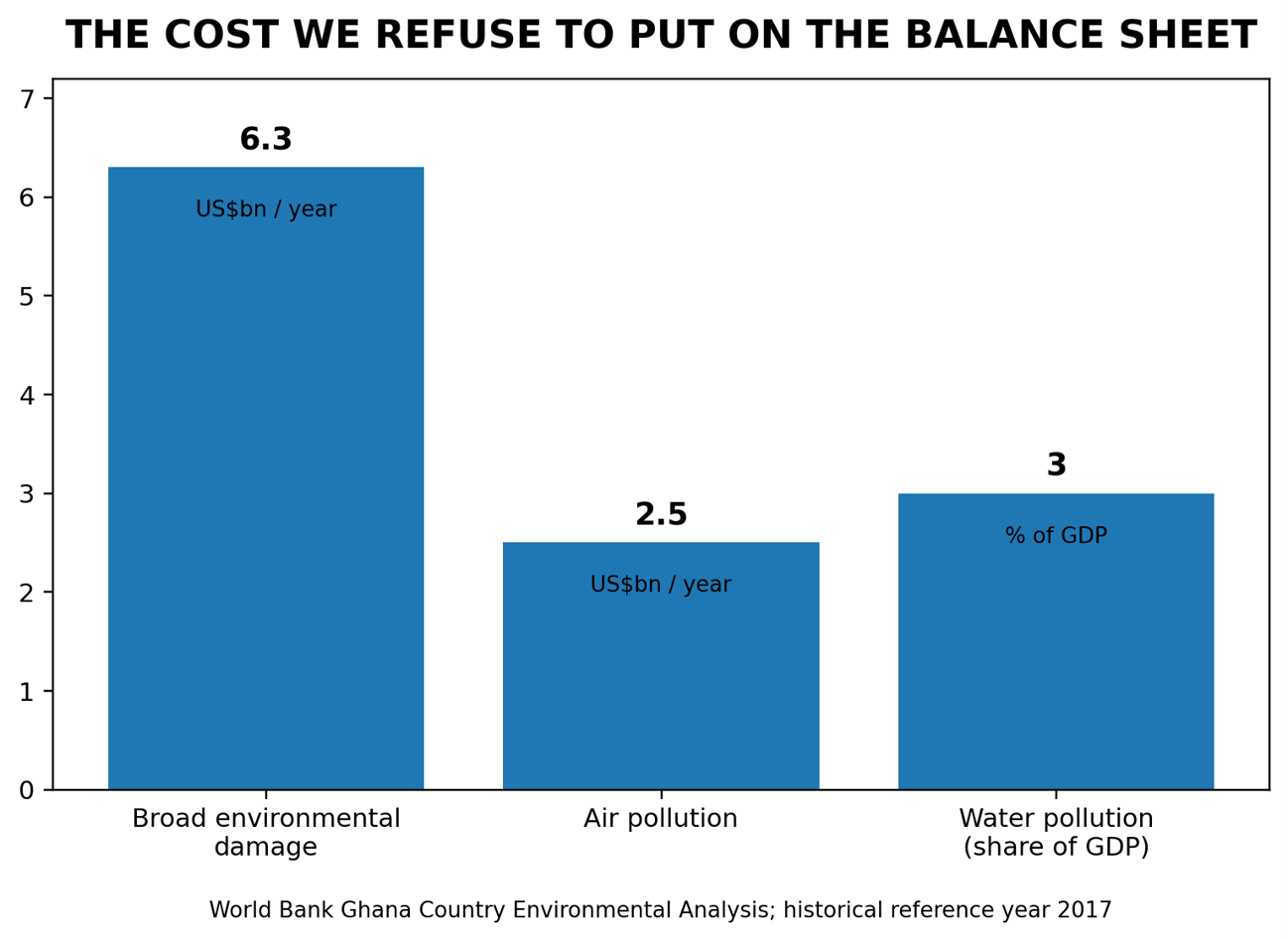
The World Bank’s Ghana Country Environmental Analysis estimated the annual cost of environmental damage at about US$6.3 billion, nearly 11 percent of Ghana’s 2017 GDP, when a broad set of environmental damages is considered. The assessment covered air and water pollution, agricultural land degradation, deforestation, illegal mining, overfishing, coastal erosion and flooding.
The same analysis estimated the cost of air pollution at about US$2.5 billion, or 4.2 percent of 2017 GDP. It estimated water pollution damage at roughly 3 percent of GDP in its analysis of environmental costs.
The economy does not exist outside nature. Agriculture requires soil and water. Fisheries require functioning rivers and other water environments. Cities require drainage and clean water. Mining requires land and infrastructure. Tourism requires landscapes. Manufacturing requires inputs and energy. Public health requires a safe environment. When environmental systems deteriorate, economic productivity deteriorates with them. The problem is that some of these costs appear in different budgets.
A water company pays for treatment. A hospital pays for illness. A farmer loses yield. A fisherman loses catch. A district assembly pays for flood clean-up. A ministry pays for restoration. A household pays for replacement water. The activity that caused the damage may not pay the full cost. In ordinary language, it is someone else’s bill.
WHAT WOULD RECOVERY LOOK LIKE?
The environmental debate often ends with a call to ‘save the rivers’. That is emotionally powerful but operationally vague. A measurable environmental recovery programme needs baselines and targets. For rivers, success could mean sustained reductions in cloudiness in the water at monitored points, recovery of aquatic habitat, lower contaminant concentrations where relevant, restored riverbanks and improved water-treatment conditions.
For forests, success could mean verified hectares restored, survival rates for planted trees after multiple seasons, reduced illegal-mining activity and recovery of environmental function.
For mining enforcement, success could mean not merely arrests but prosecutions, convictions, reduced site recurrence and recovery of unlawfully obtained assets where courts order it.
For communities, success could mean restored farmland, reliable alternative livelihoods, access to safe water and meaningful participation in environmental decisions.
For the Marine Protected Area, success could mean clear zoning, visible enforcement, community compliance, improved habitat condition and eventually stronger fish populations and livelihoods.
For plastics, success could mean higher collection and recycling rates, less leakage into water bodies, stronger producer responsibility and a viable market for recycled materials.
These indicators would change the political conversation. Instead of asking whether a government is ‘fighting galamsey’, citizens could ask whether the Pra is cleaner than it was last year. Instead of asking whether a marine protected area exists, citizens could ask whether fish biomass and habitat quality are improving. Instead of asking whether Ghana has a plastics policy, citizens could ask how much packaging is actually recovered.
Instead of asking whether land has been reclaimed, citizens could ask whether a restored site remains ecologically functional after three years. Environmental promises become credible when people can measure whether anything is actually getting better.
FIVE QUESTIONS THE GOVERNMENT MUST ANSWER
1. SHOW THE WATER
If the government says rivers are improving, the public should be able to see the evidence: sampling dates, locations, results and trends from major mining-affected waterways.
2. FOLLOW THE CASE
A seizure should not be the end of the story. Citizens should be able to follow what happened next — charges, court outcomes, equipment ownership and restoration orders, subject to lawful privacy limits.
3. PROVE RESTORATION
Planting seedlings is an activity. Restoring a forest is an outcome. Reclamation should therefore come with a public baseline, a map and a way to check whether the land remains healthy after the ceremony.
4. FOLLOW THE MONEY
The investigation should not stop with the person operating an excavator. Where the law permits, authorities should trace ownership, financing, equipment, gold buying and proceeds.
5. FOLLOW THE RIVER
A river does not know which ministry is responsible for the next kilometre. Agencies responsible for mining, forests, water, fisheries, sanitation and the coast need to share information where their mandates meet.
THE FIGHT FOR TRUST
Ghana’s environmental crisis is partly a crisis of trust. Communities hear promises to restore rivers. They hear that illegal mining will be stopped. They hear that water quality is improving. They hear that new laws will be tougher. They hear that a marine protected area will replenish fish stocks. Then they look at the river. Trust grows when what people are told matches what they can observe. None of these means a river or an ocean can be repaired overnight. Rivers may take years to recover. Forests can take decades. Contamination can remain after the original source is gone. But communities need to see that the direction is changing.
But communities need to see the direction of travel. A river that is slowly improving is evidence. A restored farm that remains productive is evidence. A protected area with clear boundaries and visible management is evidence. A prosecution that reaches a verdict is evidence. An excavator seized today and a new pit appearing tomorrow sends a message. A protected area announced without clear boundaries sends a message. A plastics policy that does not change collection rates sends a message.