





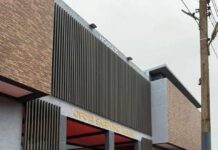




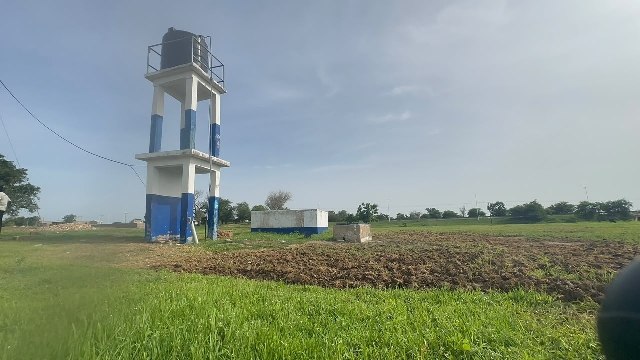

As commuters carefully navigate the pothole-ridden Bolgatanga-Navrongo stretch of the ECOWAS Road, a blue and white concrete structure stands quietly at the entrance to Amogrebisi, a farming community in Sumbrungu in the Bolgatanga Municipality of the Upper East Region.
At first glance, it appears to be another government development project designed to improve livelihoods.
However, the structure has become a symbol of broken promises.
For the farmers it was meant to serve, the only thing flowing from the project is disappointment.
“We used to cultivate rice on this land but now it lies idle because the project is not giving us the water we need,” a 45-year old farmer Atubiga Ernest in Amogrebisi community said.
“The Assembly should come and remove their project, so we can use our land again.”
In 2024, the Bolgatanga Municipal Assembly constructed and commissioned two mechanised borehole irrigation projects in the Amogrebisi and Danwoe communities under Phase One of the $150 million World Bank-funded SOCO Project at a combined cost of GH¢201,599.50.
The Assembly identified the two communities as areas where many residents depend on dry season vegetable farming.
Each project was expected to directly benefit between 30 and 40 farmers while indirectly supporting hundreds of residents through increased agricultural production and improved household incomes.
Access to reliable water had long been one of the biggest constraints facing farmers cultivating pepper, tomatoes, onions, and other vegetables in the two communities.
The mechanised boreholes were therefore intended to address that challenge, improve agricultural productivity, and strengthen the local economy.
Instead, farmers say the facilities have failed to serve the very purpose for which they were built.
For Abisibo Akolgo, a vegetable farmer in the Amogrebisi valley, the project has brought little relief.
“The water from this project cannot even reach where we farm,” he said.
“We cannot depend on it because our peppers and tomatoes will dry up. We still rely on water from the Vea Dam canal, and sometimes that canal also dries before it gets to us.”
Afedo Asoria, who has farmed vegetables in the Amogrebisi valley for 15 years, said the project initially gave farmers hope.
“If this project had worked as we were told, it would have helped many of us escape poverty and pay our children’s school fees,” he said.
He believes the outcome could have been different if farmers had been involved from the beginning.
“Nobody consulted us. They only informed us that they were bringing a SOCO irrigation project. Had they involved us during planning, we would have suggested ideas that would make it work.”
Several kilometres away in Danwoe, the situation is no different.
The mechanised borehole facility, completed under the same SOCO intervention, stands largely unused despite being officially handed over.
Farmers say it simply cannot produce enough water for irrigation.
“It doesn’t serve the purpose for which it was built,” a farmer named Akolgo George in Danwoe stated.
“They might as well remove it instead of saying they provided irrigation for us when we cannot use it.”
For Alagemah James, a farmer, the problems were evident from the first day construction began.
“The moment the contractor started work, we realised the project would fail because the outlet pipe being installed was only three-quarter inch. That size cannot supply enough water for irrigation.”
James said farmers immediately raised their concerns with the Assembly but construction continued.
He recalled the commissioning ceremony as proof of the system’s limitations.
“We waited between eight and nine hours just to fill the 350-litre tank. Imagine 30 to 40 farmers depending on that. How can this support commercial farming?”
Contract documents shown to the team by the Bolgatanga Municipal Assembly indicate that each irrigation system was to include a 1.5 horsepower pumping machine, a 10,000-litre elevated water tank and irrigation infrastructure capable of supporting dry season farming.
However, records obtained from the Ministry of Local Government, Decentralisation and Rural Development also describe the projects as having 3,500-litre tanks instead of the 10,000-litre capacity contained in the Assembly’s contract documents.
On the ground, however, the facilities are fitted with only 350-litre tanks, far less than what both documents describe.
Experts consulted during this investigation say tanks of that size are unsuitable for commercial irrigation.
The investigation also established that the projects were fitted with three-quarter inch outlet pipes, components commonly used for domestic water supply rather than irrigation systems designed to deliver large volumes of water.
Richard Abaare, an independent hydrologist based in Bolgatanga, said the infrastructure resembles a household water supply system rather than an irrigation facility.
“The use of a three-quarter-inch outlet pipe suggests the pumps are likely to be one horsepower or even 0.75 horsepower, which are generally designed for domestic use.”
Drilling expert, Nyaaba Adongo agreed, stating: “Commercial irrigation requires much more powerful systems, typically two to 2.5 horsepower pumps, to deliver sufficient volumes of water.”
The technical concerns mirror those raised by the former Bolgatanga Municipal Chief Executive, Rex Asanga.
According to Mr Asanga, the Assembly originally conceived the projects as irrigation facilities after farmers identified water shortages as one of their biggest challenges.
“The whole concept was to tap underground water to support dry season irrigation,” he said.
However, during the project monitoring, he said, he discovered that what had been constructed differed significantly from what had been envisaged.
“When I inspected the projects before completion, I realised the tanks were far too small.”
Mr Asanga said he subsequently issued query letters to the Municipal Planning Officer and the Municipal Engineer seeking explanations.
Copies of the letters obtained by the team show that he questioned why infrastructure intended for irrigation had been designed like a potable water system.
“A casual observation of what has been delivered by the contractor shows that the designs were done to provide potable water rather than irrigation purposes,” one of the letters stated.
He said the controversy damaged the Assembly’s credibility because communities felt they had been given facilities that could not meet their expectations.
According to him, the matter remained unresolved because he left office following the 2024 general elections before receiving final responses.
Former Municipal Engineer, Daniel Atchulo rejected suggestions that the projects were poorly designed.
He questioned whether Mr Asanga possessed the technical expertise to assess the designs and maintained that the facilities were completed according to specification.
Mr Atchulo also said he never received the alleged query letter, explaining that he reported administratively to the Municipal Coordinating Director rather than directly to the MCE.
Municipal Planning Officer, Juliana Agyeyomah declined to address the specific concerns raised in the queries.
“I have my personal reservations about this letter. If people want to open Pandora’s box…it will not be me. We have all tried to protect the image of the office and the municipality.”
She nevertheless said attention should now focus on finding solutions rather than assigning blame.
The investigation also established that Municipal Coordinating Director, Chimsi Musah, who was central to the administrative process, died on February 17, 2026.
Assembly contract documents, confirmed by the current Municipal Engineer, Owusu Emmanuel Kwaku, through an interaction with the team, indicate that the mechanisation component, including elevated 10,000-litre water tanks, 1.5-horsepower pumping machines, electrical connections and irrigation pipelines alone was budgeted at GH¢40,000 per project with the remaining funds covering the full completion of the facilities at the combined cost of GH¢201,599.50.
The contractor, Osman Murtala of Al-Kahf Company Limited, insisted he executed the projects according to specifications provided by the former Municipal Engineer.
“I delivered exactly what was in the contract documents. I worked under the Assembly engineers. Whatever they instructed me to do was what I did.”
For farmers in Amogrebisi and Danwoe, the debate over responsibility offers little comfort.
Their concern is the livelihoods lost, farming opportunities missed, and public resources invested in facilities that have failed to deliver the promised benefits.
The blue and white structures remain standing in both communities, overlooking farms that still struggle for water.
classfmonline