

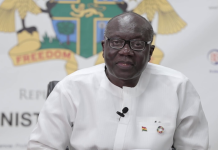













The finance minister, Dr. Cassiel Ato Forson, has cautioned that Africa risks becoming an “unintended casualty” of global inflation, rising interest rates and geopolitical shocks and pressed for concrete mechanisms to secure financing for the continent’s development, climate and security priorities.
He argued that while crises often generate spillover benefits for advanced economies, they leave Africa grappling with debt-distress, currency volatility and shrinking fiscal space – deepening the continent’s vulnerabilities.
This imbalance highlights the urgency of redesigning global financial architecture to ensure Africa can withstand external shocks and mobilise the resources it needs to drive growth, protect livelihoods and meet climate obligations.
In an address read on his behalf – ‘Africa’s debt crisis, a worsening challenge’ – at the African Conference on Debt and Development (AfCoDD V) 5th edition in Accra, he asserted that Africa’s debt vulnerabilities continue deepening despite repeated attempts to address them.
“The IMF estimates that 21 low-income African countries are either in or at high risk of debt distress. The continent faces huge debt burdens – external debt increased to US$650bn in 2025 with an annual debt service burden of about US$90 billion, severely crowding out critical spending on infrastructure, education and health.”
He attributed some of the underlying drivers to domestic revenue mobilisation challenges, currency depreciation and exchange rate risks, dependence on commodity exports and rising global interest rates driven by the tightening of monetary policy in advanced economies. ash kash onlyfans leak amadeogarcia393
“More fundamentally, the financing challenges facing African countries are symptomatic of deeper structural shifts requiring a more comprehensive approach. With global interest rates at elevated levels – particularly U.S. Treasury yields at 4 percent to 5 percent – many African nations are unlikely to regain meaningful access to international capital markets in the short-term,” he said.
He noted that the conditions which supported previous waves of Eurobond issuance, when rates hovered near 1–2 percent are no longer in place.
“The so-called ‘African premium’ raises borrowing costs beyond global benchmarks. For instance, while the 6-month Euribor was 0 percent pre-2020 it now stands at about 2.0 percent – making market access for Africa even costlier.”
In view of this, he maintained that the combination of higher borrowing costs, weak fiscal buffers and limited concessional resources has undermined debt sustainability and made crisis resolution more urgent.
Citing Ghana’s debt situation in the recent past, he said the new administration has introduced significant reforms to restore debt sustainability. This includes a stronger fiscal framework, prudent debt management and growth-oriented initiatives, among others.
Looking beyond Ghana, he stressed the need for a strategic shift involving a rethink of global financial governance to better integrate African development priorities. This, he said, should also include strengthening regional financial institutions and expanding concessional and blended finance options.
AfCoDD V, a three-day event, is being held under the theme ‘Africa’s Debt Crisis: A Reparations and Reparative Justice Framework Analysis’.
The conference is organised by the African Forum and Network on Debt and Development (AFRODAD) in partnership with International Development Economics Associates (IDEAs) and the Stop the Bleeding Campaign.
Chairperson-AFRODAD Board of Trustees Barbara Kalima-Phiri said this theme recognises the historical injustices that have left structural and systemic inequities across Africa.
She noted that: “Africa’s wealth and labour have long been extracted to benefit others, beginning with the trans-Atlantic slave trade, colonial exploitation and apartheid and persisting through today’s unequal global systems – leaving structural legacies that continue to limit the continent’s full freedom and sovereignty.
“This history is not just behind us – it lives in the unjust debt burdens, the inequities and systemic barriers our people face today. The world owes our mothers, our fathers and our forefathers and our children not just an apology but reparations. The call for reparations is not just about compensation, it is about the truth,” she said.
Kalima-Phiri added that the African Union this year held its first-ever Pan-African Conference on debt, producing the Lomé Declaration – a comprehensive agenda to reform the global debt architecture. With work on an African Credit Rating Agency, the African Continental Free Trade Area and Agenda 2063 making progress, she said “The Africa we want is truly underway”.
She maintained that the decade of demanding reparations and reparative justice is another step toward entrenching Africa’s position as “the rule maker, not rule taker”.
thebftonline.com