














Part 1 of 7: The City, the Rain, and the Planning Question
By CQ The Illustrator
Every rainy season, Accra behaves as if water has committed a surprise attack.
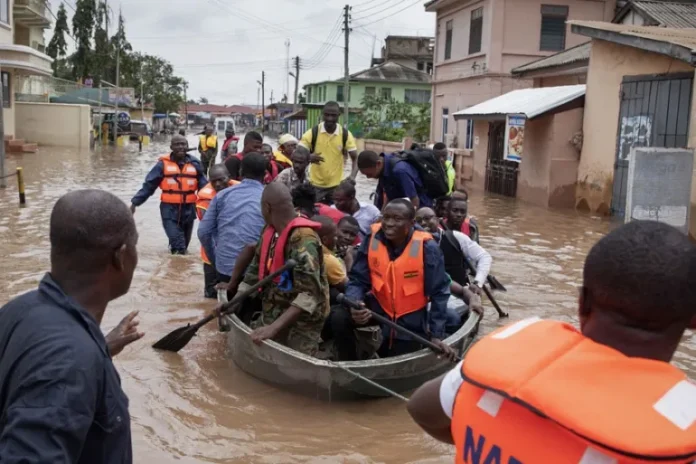
The clouds gather. The drains overflow. Roads vanish under brown water. Homes flood. Shops shut. Drivers calculate risk with their tyres. Commuters remove their shoes and waddle through floods. Radio stations open their phone lines. Officials tour affected areas. Everyone agrees the situation is serious.
Then the sun returns, the water recedes, and Accra quietly prepares to forget.
Until the next rain.
Yesterday’s flooding should therefore not be treated as breaking news. It is a reminder. Heavy rains that began late on Sunday, June 28, and continued into Monday, June 29, 2026, flooded parts of Accra, disrupted the morning commute and affected places including sections of the N1 Highway, Apenkwa toward Tesano, the Accra-Kasoa stretch, Weija, Mallam, Achimota, Spintex, Atomic in Madina, Kaneshie, Darkuman Junction, parts of the Kwame Nkrumah Interchange and much more of Accra. That list is not random. It reads like a map of a city whose water pathways have been crowded, hardened, blocked and disrespected.
So let us begin with the first uncomfortable truth: Accra did not flood by accident. Accra flooded because we interrupted the journey of water.
Water has memory. It remembers the stream that once flowed quietly before somebody called the land “available.” It remembers the wetland that once absorbed the excess before somebody filled it with laterite. It remembers the low-lying corridor that once carried runoff to the sea before somebody drew a site plan over it. You can sell a waterway. You can fence a buffer. You can roof a floodplain. You can rename a swamp as an estate. But when the rain comes, water will still look for its old road.
That is the story this series will tell. Not the lazy version that says Accra floods only because people throw rubbish into gutters. Not the partisan version that says one government caused the flood and another government can cure it with a press conference. Not the sentimental version that treats every rainy-season disaster as an act of God. The real story is more stubborn: Accra’s flood problem is a planning problem before it is a drainage problem.
Yes, choked drains matter. Waste matters. Desilting matters. Climate change matters. But none of these explanations is complete on its own. A city does not flood year after year simply because the clouds are wicked. It floods when the land has been badly organised, the water has been badly routed, the laws have been badly enforced, and the natural systems that should help the city breathe have been treated as vacant plots.
To understand Accra’s flooding, we must first understand the Odaw Basin.
The Odaw Basin is not just a river on a map. It is Accra’s central water corridor. GARID identifies the Odaw River and its tributaries (Nima, Onyasia, Dakobi and Ado) as the system that drains major urbanised areas of Accra, including the Accra Metropolitan Assembly, Ga East, Ga West and Adentan. The project documents put the basin at roughly 250 square kilometres. In plain language, much of central urban Accra sends its rainwater into one overburdened drainage machine.
That machine has a simple logic. Rain falls across neighbourhoods. The water runs into tributaries and drains. The tributaries feed the Odaw. The Odaw pushes toward the Korle Lagoon. The Korle Lagoon should receive the flow and help discharge it toward the Atlantic. When this chain works, the city may still have heavy rain, but the water has somewhere to go. When the chain is narrowed, choked, silted, built upon or delayed at the outfall, rain becomes a public emergency.
This is why places such as Nima, Alajo, Odawna, Kaneshie, Avenor, Circle, Agbogbloshie, Old Fadama, Graphic Road and the Korle Lagoon area are not merely unlucky. Many of them sit within, beside or downstream of Accra’s old water logic. When the basin is overloaded upstream, the pain is carried downstream. When the downstream outlet struggles, the pressure is felt upstream. Flooding is not always a local event; sometimes it is the entire basin sending a message.
The second uncomfortable fact is that the Odaw Basin has become heavily urbanised. A peer-reviewed land-use and land-cover study by Edward Kofi Ackom, Kwaku Amaning Adjei and Samuel Nii Odai found an upsurge in settlement of about 238.20 percent in the Odaw River Basin between 1991 and 2016, using Landsat imagery and classification methods. The same study projected further conversion of open forest, bare land and closed forest into settlement by 2030.
That number matters because concrete changes water behaviour. Roofs, roads, pavements, compacted yards and paved compounds do not absorb rain the way soil, vegetation and wetlands do. They accelerate it. They turn rainfall into runoff. They send more water, faster, into drains that were not built or maintained for that level of pressure. The city increases the water, narrows the route, and then blames the rain for being disrespectful.
GARID’s own basin documentation describes the built-up Odaw River Basin as low-lying, overcrowded, lacking adequate sanitation and drainage infrastructure, and having high impervious land cover that produces high runoff under rainfall. That is a technical way of saying something ordinary residents already know: when Accra rains hard, water no longer has enough ground to enter, enough space to wait, or enough clear channel to leave.
The third fact is that Accra was not designed to survive on roadside gutters alone. Ghana’s Water Infrastructure Framework records Accra-specific drainage master-planning exercises going back decades: an overall drainage master plan for main watercourses in Accra Central in 1963, a 1967 addendum for the Ministries, Christiansborg and Central Town areas, a 1991 feasibility study for flood-mitigation interventions, and a 1995 review and update centred on the Odaw stream and its tributaries.
That planning history changes the argument. It means the country has known for a long time that Accra needs basin-level drainage planning, not just emergency gutter clearing. The old question was not whether water exists. The question was how to guide it. The tragedy is that the guiding system was only partly built, partly maintained, and repeatedly undermined by the way the city grew.
Then come the wetlands.
Accra’s wetlands are not useless bush. They are not waiting rooms for real estate. They are part of the city’s natural flood infrastructure. Wetlands hold water. They slow water. They filter water. They give stormwater room to spread without immediately entering bedrooms and shops.
This is why the Densu Delta and Sakumo Ramsar Site matter.
On the western flank of Accra, the Densu Delta Ramsar Site is not merely a bird habitat; it is also a lower Densu floodplain and wetland system. A 2024 peer-reviewed study by Charles Yaw Oduro, Prince Aboagye Anokye and Michael Ayertey Nanor examined urban growth around the Densu Delta using remote sensing, ground truthing, key informant interviews, land-use/land-cover analysis, building coverage analysis and spatial regression. The authors identified spreading, ribbon and village-magnet patterns of growth, driven mainly by residential land demand and weak control of development.
Another 2024 encroachment study on the Densu Delta reported that, over a twenty-year period, built-up area increased by 10.3 percent while wetland declined by 2.6 percent, with further built-up growth projected by 2030 if current trends continue. That is not an environmental footnote. It is a flood warning written in land-cover data.
To the east, the Sakumo Ramsar Site tells a similar story. Drone-based research by Agbeti and colleagues found that about 38.3 percent of the wetland had been lost to encroachment and that parts of the 100-metre buffer had been eaten into by development. A later satellite-based study of the Sakumono Ramsar Site found built-up area rising from 1.06 percent in 2000 to 45.26 percent in 2023, while floodplain area fell from 82 percent in 2000 to 22 percent in 2023.
Pause on that.
We are not only losing wetlands; we are losing waiting rooms for water. When the waiting room is sold, the water enters the main hall.
The fourth fact is perhaps the most embarrassing: Ghana is not suffering from an absence of paper. There are laws. There are policies. There are plans. There are authorities. There are frameworks. The Land Use and Spatial Planning Act exists. Building regulations exist. Ramsar regulations exist. The Ghana Hydrological Authority exists. The NDPC has frameworks. Assemblies have enforcement powers. Officials have speeches. Consultants have reports. Committees have minutes.
On paper, Ghana understands flooding.
On the ground, Accra still drowns.
The Auditor-General’s 2021 performance audit makes the implementation gap painfully clear. Between 2015 and 2019, the Ministry of Works and Housing and the Hydrological Services Department constructed only 12.2 kilometres of drains out of a targeted 110 kilometres, an achievement rate of 11.1 percent. The audit also found that no retention ponds were developed against targeted basins for 2018 and 2019, even though such ponds are essential because a city must not only carry water away but also temporarily hold it.
This is the heart of the Accra problem. The city is not merely wet; it is under-planned in practice. It has laws without enough enforcement, plans without enough implementation, drains without enough capacity, wetlands without enough protection, and communities without enough safety.
The citizen is not innocent either. We want enforcement, but not on our plot. We want drainage reservations, but not when a chief, family head, developer or friend says the land is available. We want the assembly to demolish illegal structures, but we shout when the bulldozer reaches somebody we know. We condemn rubbish in drains, but tolerate rubbish in the daily discipline of the city. We want planning until planning says no.
The official is not innocent. The developer is not innocent. The politician is not innocent. The citizen is not innocent. Accra’s floodwater is a collective audit.
That is why this series is not about rain alone. It is about planning. It is about whether Ghana can make a rule and obey it. It is about whether a city can protect invisible systems before they become visible disasters. It is about whether we can admit that a wetland is infrastructure, a buffer is protection, a drain is not a dustbin, and a floodplain is not a bargain plot.
A serious city plans for rain before the clouds gather. It protects waterways. It keeps overland drainage corridors open. It preserves wetlands. It builds detention ponds. It maintains drains. It maps flood risk. It enforces building codes. It stops illegal development early, not after roofs, families, churches, schools and livelihoods have been planted in danger.
Accra does not have to abolish rain. No city can. Climate patterns are changing and extreme rainfall is becoming harder to manage. But a serious city reduces predictable disaster. It does not repeat the same tragedy every rainy season and call it nature.
So, from today, let us change the question.
Not only: why did the drains choke?
Ask: Who narrowed the waterway? Who sold the buffer? Who approved the permit? Who ignored the master plan? Who delayed the drain? Who failed to maintain the channel? Who built on the wetland? Who looked away until the flood arrived?
The rain is not the only suspect.
In the next part, we will follow the water through the Odaw-Korle system and explain how Accra was supposed to drain, from tributaries and channels to lagoon and sea. Because to fix a flooded city, we must first remember the city beneath the city: the Accra of streams, wetlands, floodplains, lagoons and old water paths.
For now, let us begin with the truth we avoid every rainy season:
Accra’s flood problem is not only in the drains. It is in the planning.
#CQTheIllustrator | #CivicConscience | #SharpInk | #TheCivicQuill | #GhanaFirst
#AccraFloods
#PlanTheCity