












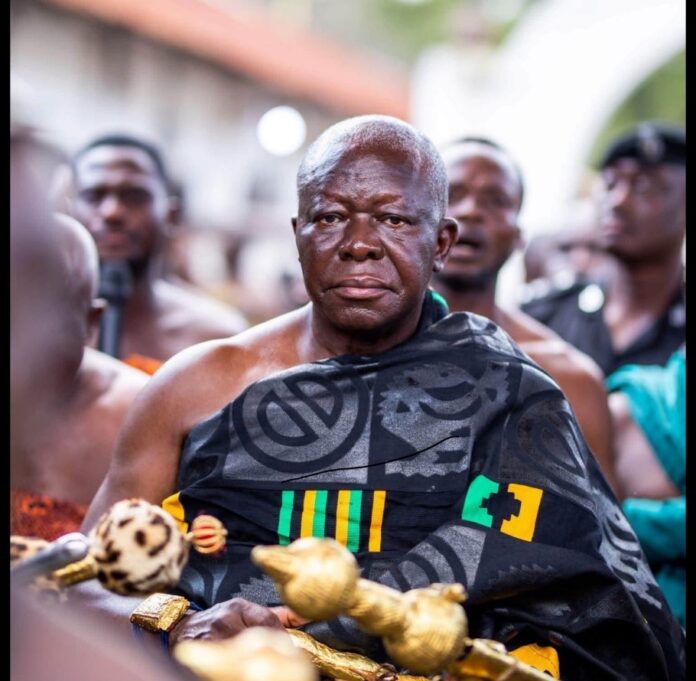

At the 2026 Mining in Motion Conference in Accra, the Asantehene, Otumfuo Osei Tutu II’s address, read on his behalf by the Essumejahene, Nana Okyere Kusi Ntrama, was not a routine royal endorsement.
It was a carefully layered intervention that sought to lift a bitterly contested policy debate above partisan politics and place it within a longer story of national economic sovereignty.
At its heart was a simple but radical proposition that, Africa must stop being a supplier of raw minerals and become an owner of mining giants.
“Just as in the Emirates, in the Middle East, right ahead in oil billionaires of the world, so some of the sons of Africa will also be created,” he said.
He added: “The Oppenheimers, the De Beers, the Patrice Motsepes, the Ibrahim Mahamas, should be created in Africa. So, we keep the value here in Africa.”
That call connected directly to the government’s “Reset Agenda,” including the establishment of the Ghana Gold Board (GoldBod), and a broader push to process minerals locally.
The Asantehene acknowledged the controversies surrounding the GoldBod but insisted they should not obscure the bigger objective. “Regardless of the controversies surrounding the GoldBod, there can only be no doubt that the nature of the President’s Reset agenda is intact,” he said.
Historical reckoning
The most striking feature of the speech was its historical framing. The Asantehene traced the current reforms back to Ghana’s first President, Dr Kwame Nkrumah, who sought to bring minerals under state control and establish a gold refinery in Tarkwa.
That project was abandoned after the 1966 coup, a historical wound that the current “Reset” is now expected to heal.
“It takes us right back to the very foundation of our republic,” he said. Nkrumah, he added, “paid a heavy price for this audacity.”
By linking the GoldBod and local processing to Nkrumah’s unfinished vision, the Asantehene reframed a contemporary policy fight as a matter of historical redemption. Opposition to the “Reset,” in this telling, is not merely opposition to a government but it is opposition to the nation’s own destiny.
The cartel warning
The speech was also notable for what it identified as the enemy. The Asantehene warned that “those who benefited from Ghana’s old mining system may resist President Mahama’s new reforms.”
He spoke of a “cartel” of local and international interests that would try to block change. By naming an adversary, he provided the government with a rallying point and pre-empted expected backlash from entrenched interests.
The context makes the intervention even more consequential. The government has announced a phased ban on raw mineral exports by 2030 and pushed local content policies requiring Ghanaian companies to take over contract mining from major foreign firms.
The GoldBod itself remains controversial, with critics raising concerns about its operations and financial risks.
Against that backdrop, the Asantehene’s endorsement offers crucial moral cover, while his warning gives the government a narrative to explain resistance.
Royal endorsement
Yet the speech was not unconditional. The Asantehene urged that Ghana’s long-term mining strategy be kept above partisan politics, ensuring consistency across successive governments.
That is a subtle but important condition that, the “Reset” must not become the property of one administration. It must become national policy, anchored in consensus.
The true test, however, lies in implementation. Can the government manage the operational crises surrounding the GoldBod? Can it build genuinely competitive local industries rather than simply replacing foreign cartels with domestic ones? Can it withstand the pushback the Asantehene has so publicly predicted?
The Asantehene’s speech did not answer those questions. But it changed the terms of the debate. It gave the mining “Reset” a moral framework, a historical mandate and a named adversary. In doing so, it turned a contested policy into a national project, and placed the weight of the Golden Stool behind it.