












The UN Secretary-General’s Special Advocate for Financial Health met women entrepreneurs using Affinity’s banking services, highlighting the role of accessible financial solutions in supporting small businesses and building financial resilience.
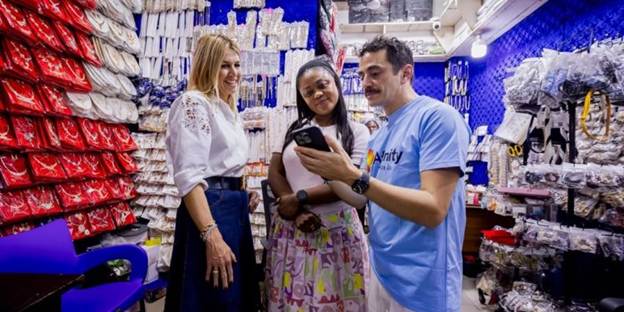
Affinity Africa, Ghana’s leading digital banking platform, was part of Her Majesty Queen Máxima of the Netherlands’ official programme in Ghana, which included a visit to Affinity customers at Makola Market in Accra on Tuesday, 3 November. Queen Máxima, who serves as the United Nations Secretary-General’s Special Advocate for Financial Health (UNSGSA), met women traders using Affinity’s financial services and heard firsthand how access to payments, savings and loans is helping entrepreneurs manage their finances, run their businesses and plan for the future.
During her 2–5 November visit, focused on advancing financial health in Ghana, Queen Máxima spoke with Joyce Ketu, an Affinity customer rebuilding her business following a fire. Her experience highlighted how access to savings, loans and personal support can help small business owners navigate financial challenges, while underscoring the importance of insurance, which Affinity is introducing, and longer-term financing in protecting livelihoods and supporting future growth.
For many small business owners, financial health means balancing the needs of their businesses with those of their households. Having money available to restock, cover everyday expenses and cope with unexpected setbacks can make a significant difference to their financial stability.
“Financial inclusion is not simply about giving people access. It’s about providing the tools they need to manage their finances, grow their businesses and build resilience for when unexpected challenges arise,” said Dr Tarek Mouganie, Founder of Affinity Africa. “The experiences shared by entrepreneurs at Makola Market reflect the realities of millions of people across Ghana. At Affinity, we’re building banking services that are accessible, affordable and genuinely relevant to our customers’ everyday lives. That is financial health.”
Since launching publicly in October 2024, Affinity Africa has reimagined banking through a fully digital platform offering free personal and business accounts, savings, investment products, seamless payments, transfers, and one of Ghana’s most affordable lending portfolios. The company has grown to over 150,000 customers.
HM Queen Máxima’s visit comes at an important moment for Ghana’s financial sector. According to the World Bank’s Global Findex 2025, 81% of adults held a financial account in 2024, up from 29% in 2011. Yet ensuring that greater financial access translates into lasting financial health remains a critical priority.
FOR FINANCIAL HEALTH (UNSGSA) with Joyce Ketu, Affinity Customer
About Affinity Africa
Affinity Africa is a digital banking platform headquartered in Ghana, dedicated to providing affordable and accessible financial services to underserved and unbanked individuals, and micro, small, and medium enterprises (MSMEs). Powered by a proprietary technology platform, a branchless business model, and robust credit underwriting capabilities, Affinity offers 24/7 banking services tailored to both digital natives and users with limited digital literacy, driving financial inclusion at a low cost. With instant digital onboarding, no monthly fees, and high interest on savings accounts, Affinity is among the most affordable and cost-effective players in the region.
The company was founded in 2022, when it received a Savings and Loans license from the Bank of Ghana, the first of its kind granted in over 10 years, and officially launched operations in October 2024, following the regulatory approval of its mobile app. Today, it offers a comprehensive suite of products, including personal and business accounts, savings, payments, transfers to banks and mobile money wallets, investments, and loans.Affinity has made a profound impact in the region. It has empowered a large, underserved population with easy-to-use, affordable banking services, and it has brought over 150,000 Ghanaians into the system, many of whom had previously been neglected by traditional financial service providers.