













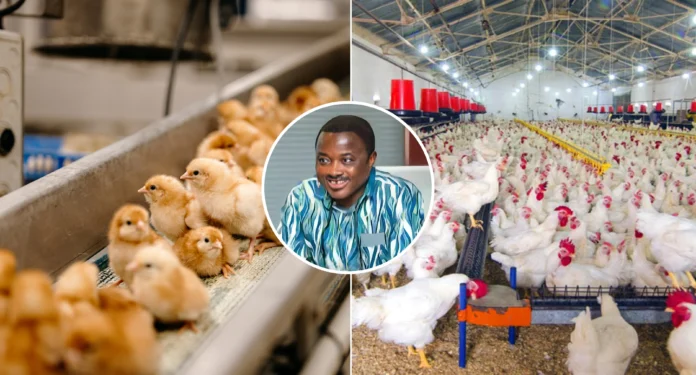

Ghana’s proposed poultry master plan promises import reduction and agro-industrial growth, but egg gluts, import competition, financing gaps and implementation concerns threaten successful implementation of the plan.
The Government of Ghana says it is positioning the poultry industry as a strategic pillar for economic transformation, with plans to roll out a coordinated national master plan aimed at reducing imports, boosting local production, and attracting investment.
But beneath the ambition lies a more difficult question: can a sector struggling with egg gluts, import pressures, financing gaps and farmer frustration realistically deliver the agro-industrial transformation government is promising?
That tension came into sharp focus at the national poultry master plan stakeholders’ dialogue, where government officials, farmers, financiers and development partners gathered to discuss what is being presented as a long-term rescue and expansion strategy for Ghana’s poultry industry.
Speaking on behalf of the Minister for Food and Agriculture, Technical Advisor at the Ministry, Mr. Kwesi Etu-Bonde, described the proposed National Poultry Master Plan as a decisive shift away from fragmented interventions toward a coordinated national industrial strategy.
“Ghana continues to face a structural imbalance , which is high domestic demand for poultry but limited local supply capacity. The result is heavy import dependence, which puts pressure on foreign exchange and weakens the domestic industry,” he said.
His remarks reflect a growing recognition within government that poultry is no longer simply an agricultural subsector, but a strategic economic issue tied to food security, jobs, industrialisation and import substitution.
Yet the industry government hopes to transform is simultaneously battling one of its most difficult moments in recent years.

Poultry Sector Faces Contradictions
While Ghana spends hundreds of millions of dollars annually importing frozen chicken products, local poultry farmers say they are increasingly unable to sell eggs and locally produced poultry at sustainable prices.
The Bono Poultry Farmers Association recently warned that the sector is facing its worst egg glut in years, with thousands of crates remaining unsold as cheaper imports from Côte d’Ivoire flood local markets.
The situation exposes a major contradiction at the heart of Ghana’s poultry economy: shortages in some parts of the value chain coexist with oversupply and market failures in others.
For many farmers, the problem is not simply production, but weak market systems, inconsistent policy protection, and the absence of structured offtake arrangements.
This is precisely where the proposed master plan claims it intends to intervene.
Mr. Etu-Bonde acknowledged that previous government and donor-backed interventions have often failed to produce lasting structural change because they operated in isolation.
“This master plan must move beyond piecemeal interventions. It is designed as an end-to-end transformation agenda that coordinates all actors within the value chain,” he explained.
Beyond Production: A Full Value Chain Strategy
Unlike earlier programmes that focused largely on increasing bird numbers or distributing inputs, the new strategy seeks to address the entire poultry ecosystem from feed production and hatcheries to processing, cold storage, logistics and market access.
Government says the objective is to build a more integrated poultry economy capable of reducing Ghana’s dependence on imported chicken while creating jobs for youth and women.
“Poultry is not just a subsector. It is a strategic economic priority that can drive employment, support agribusiness growth, and contribute to Ghana’s industrialisation agenda,” Mr. Etu-Bonde stressed.
Among the interventions being proposed are investments in irrigation and mechanisation to reduce feed costs, support for hatcheries and breeder farms to improve access to quality chicks, expansion of veterinary and extension services, and development of cold-chain infrastructure.
Government also intends to pursue regulatory reforms aimed at creating what officials describe as “fair competition” between local producers and imported poultry products.
The Nkoko Nkitikiti Factor
The master plan discussions are also unfolding against the backdrop of ongoing concerns surrounding the government’s Nkoko Nkitikiti programme, which was introduced to support poultry production and reduce imports.
Some poultry farmers have recently protested what they describe as exclusion from the intervention, raising broader concerns about transparency, beneficiary selection and equitable access to government support programmes.
Those concerns point to one of the biggest risks facing the new poultry master plan: implementation credibility.
Agricultural policies in Ghana have historically struggled not because of poor ambition, but because of weak coordination, political interference, inconsistent funding and uneven execution.
For many industry players, the success of the poultry master plan will depend less on policy announcements and more on whether government can build trust within the industry and sustain implementation beyond political cycles.
The Import Question
Perhaps the biggest test for the master plan will be whether Ghana is truly prepared to confront the economics of imported poultry.
Imported frozen chicken products often arrive cheaper than locally produced alternatives due to scale advantages, subsidies in exporting countries, and lower production costs abroad.
This creates a difficult balancing act for policymakers.
Protecting local producers through tariffs or import restrictions could stimulate domestic production, but it could also increase prices for consumers already facing high food inflation and weak purchasing power.
Without significant improvements in productivity and efficiency, local producers may still struggle to compete even with stronger policy protection.
Analysts say reducing feed costs will be particularly critical, as maize and soybean prices continue to account for a substantial share of poultry production expenses.
Financing and Infrastructure Remain Weak Links
Access to finance remains another major structural challenge.
Although government is encouraging banks and financial institutions to develop tailored financing instruments for the poultry sector, many lenders still consider agriculture high-risk due to disease outbreaks, market volatility and climate-related disruptions.
Cold chain infrastructure also remains underdeveloped, limiting the industry’s ability to store and distribute products efficiently.
The current egg glut itself partly reflects inadequate storage, weak aggregation systems and limited processing capacity.
Without investments in logistics and market coordination, increased production alone could simply deepen market distortions rather than solve them.

Can Poultry Drive Industrialisation?
The government’s broader argument is that poultry can become a catalyst for agro-industrial transformation.
The logic is compelling. A successful poultry industry stimulates demand for maize and soybeans, creates jobs in feed milling, hatcheries, transport, processing and retail, and reduces pressure on foreign exchange reserves by cutting imports.
The sector also has relatively fast production cycles compared to many other agricultural industries, making it attractive for youth employment and SME participation.
The challenge, however, is scale and consistency.
Pilot interventions such as the Happy Broiler Project have demonstrated some success when farmers, processors, financiers and markets operate within coordinated ecosystems.
But translating pilot successes into nationwide industrial transformation is a far more complex undertaking.
“Pilot successes must now translate into national-scale transformation. Incremental improvements alone will not be enough,” Mr. Etu-Bonde noted.
A Test of Ghana’s Agro-Industrial Ambition
Ultimately, the proposed National Poultry Master Plan may become a broader test of Ghana’s industrial policy credibility.
If executed effectively, it could help reduce import dependence, strengthen food security, create jobs and build local agribusiness capacity.
If poorly coordinated, however, it risks becoming another well-intentioned policy framework weighed down by structural bottlenecks, financing constraints and implementation gaps.
For now, the poultry industry sits at a crossroads: caught between government ambition, market realities, and a growing demand for policies that move beyond rhetoric to measurable transformation.
thehighstreetjournal