









By Felix Dela Klutse (The writer works with Pent Media Centre)
September 17, 2024
From the choking gutters of Accra to the once-pristine shores of Jamestown, plastic waste is everywhere—filling drains, clogging beaches, poisoning soil, and suffocating the sea.
The relentless tide of plastic waste is not just a local crisis but a stark symbol of global environmental injustice, revealing a world where the poor bear the brunt of pollution while wealthier nations look away.
Every year, Ghana discards more than one million tonnes of plastic waste. This is equivalent to the weight of over 500,000 cars or approximately 31 kilogrammes (68 pounds) of plastic per person. To put it into perspective, this figure may be modest compared to the consumption in the United States or the United Kingdom, but Ghana faces a unique and brutal reality: it imports over two million tonnes of plastic products annually, making it a dumping ground for the world’s discarded plastics.
The Earth Care Ghana, an NGO, paints a grim picture of this menace in its report: “Ghanaians rank among the top plastic dumpers in West Africa, alongside Nigeria. But Ghana’s plastic pollution is no accident; it is intricately linked to a global supply chain that offloads pollution onto vulnerable countries.”
It added: “Overall, the country discards more than one million tonnes of plastic each year – weighing as much as more than 500,000 cars. That’s around 31 kg (68 lb) of plastic waste for every person. It’s a small fraction of the amount consumed by people in the United States and United Kingdom, which are among the world’s worst plastic polluters.”
According to a 2023 report by Greenpeace, an independent environmental campaigning organisation, over 70 per cent of plastic waste shipped from developed countries to Africa and Asia is unrecyclable or contaminated.
Plastic Pollution: More Than Just Garbage
Plastic pollution is not simply an aesthetic issue; it is a public health emergency and an environmental catastrophe. Streets become rivers of waste during the rainy season as blocked drains overflow, spreading disease. Beaches once teeming with marine life are now littered with bags, bottles, and fragments that poison fish and birds. Soil contamination hampers agriculture, threatening food security, while microplastics infiltrate the oceans, harming ecosystems vital to millions.
Local rivers and the Atlantic Ocean suffer from plastic waste suffocating marine species, causing long-term damage to Ghana’s fishing communities, which depend on healthy waters for their livelihoods.
“This vicious cycle traps the most vulnerable populations, deepening poverty and environmental degradation,” Engineer Felix Atsrim, CEO of Fedems, who has been championing the cause of environmental sustainability over10years has stated.
Plastic bags are indiscriminately used by vendors in cities and towns across Ghana. Almost 8.2 billion sachets of water are consumed in Ghana, according to World Bank Report 2020, disclosing that an estimated 86 percent of Ghana’s waste plastic load, is improperly disposed off resulting in plastics clogging up stormwater drains, rivers, and streams and ending up in the oceans. The World Bank Report further estimated that 250,000 metric tons of plastic waster are dumped from Ghana into the Atlantic Ocean.
Contributing, Mr. Richard Adjei-Poku, the Executive Director of the Livelihood and Environment Ghana, an environmentally centred organisation has lamented: “It is sad to note that in Ghana only nine percent of the waste is recycled, 41 percent is collected, and 50 percent remains uncollected, and the nation spent close to $6 billion in cleaning plastic waste every year.”
Plastics are extraordinarily useful and cheap. They are widely used in food packaging due to their versatility, durability, and lightweight nature. They effectively protect food from spoilage and contamination, reduce transportation costs, and keep food prices affordable. Additionally, they offer hygienic packaging solutions that can be produced in sterile conditions, minimising the risk of foodborne illnesses and enhancing consumer safety.
However, the proliferation of plastics creates significant health and environment concerns. Chemical additives in plastics, notably Bisphenol A, phthalates, brominated flame retardants, and heavy metals pose risks to ecological integrity and human well-being. The migration of these additives from plastics into human systems, primarily through food contact, can lead to adverse health outcomes including decreased fertility, heightened cancer risks, cognitive impairment, and hormonal disruption. Humans at vulnerable developmental stages are particularly susceptible to the effects of such toxins. Epidemiological studies correlate exposure to plastics-associated chemicals with prevalent disease trends, such as elevated incidences of prostate cancer, breast cancer, and reproductive disorders.
The environmental impact of plastic pollution is equally severe. Marine plastic pollution entangles and is ingested by marine life, causing habitat alteration and intricate challenges to ecosystem health and human food security. Freshwater ecosystems also face significant threats from plastic waste, including entanglement, ingestion, and chemical contamination. The combustion of plastics, a common practice in Ghana, emits toxic compounds and greenhouse gases, exacerbating air pollution and contributing to climate change. Improper processing of electronic waste releases persistent organic pollutants that pose substantial health risks upon inhalation or ingestion.
Indiscipline has been a major cause of plastic pollution in Ghana. A number of people in Ghana blatantly dispose of plastics such as black polythene bags, sachet and bottles improperly without recourse to the debilitating effects of their action in the short and long terms.
A rigorous public education must be embarked on by the National Commission for Civic Education and other stakeholders to help curtail this act, but this yielded little results.
The Invisible Army: Ghana’s Waste Pickers
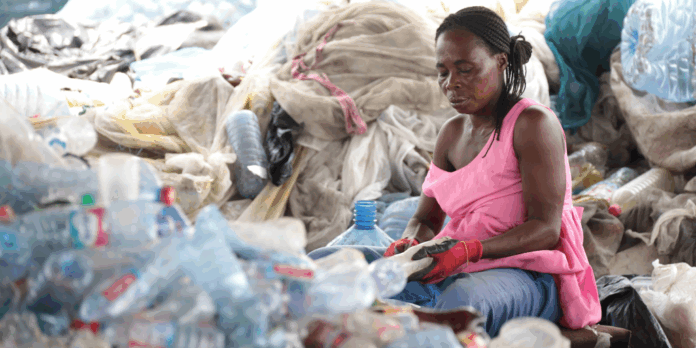
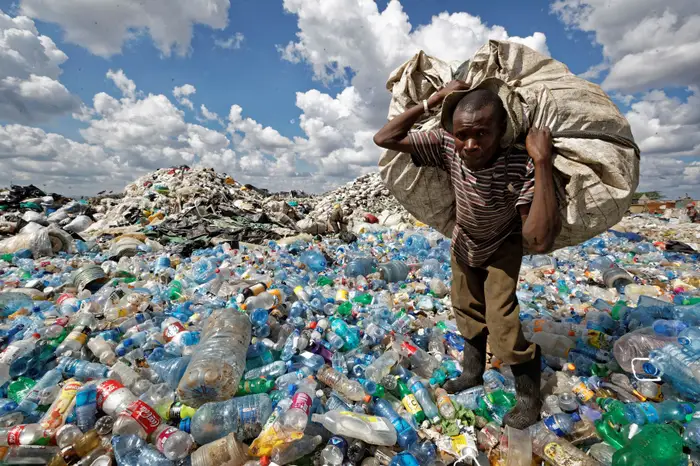
Amidst this overwhelming tide of pollution, a quiet, often invisible workforce fights daily to stem the plastic tide. Waste pickers—thousands of men, women, and even children—scavenge streets, gutters, and dumpsites to collect plastic waste. Their labour, though essential to the survival of the country’s waste management system, is unrecognized, underpaid, and stigmatised.
While wealthy nations export their plastic waste to countries like Ghana, dumping pollution without consequence, the frontline workers—waste pickers—receive none of the rewards, only the risks. Plastic has become a global weapon of environmental injustice, poisoning the poorest communities while corporations and governments stall. While leaders argue about plastic bans and companies sell “offset” plans, a quiet group of workers is doing the hard job—saving the country one bottle and one bag at a time.
Meet Lydia Bamfo: a mother of seven, an orphan-turned-activist, and the unlikely general of Accra’s invisible army of waste pickers. For 25 years, she’s battled the plastic tide—not with machines or mandates, but with bare hands, boundless will, and the belief that even in a city suffocating in garbage, dignity can be reclaimed.
Six days a week, at dawn, the 51-year-old mother of seven sits in her small shack by a yard full of recyclable trash. A motor tricycle rattles down the rough road and stops nearby. With her hair covered to keep out the dust, Bamfo jumps in beside the driver, holding her dress as they speed past wooden shops.
On a richer street, the tricycle stops outside a house with tall white walls and an electric fence. A door opens, and a tired-looking man in a dressing gown silently hands them a bag of trash. The tricycle then heads toward the city outskirts, away from the pollution, where banana plants grow well.
Along the way, Bamfo spots a group of waste pickers with hand barrows, all collecting the city’s endless plastic waste. Back at the yard, out of the sun, she finds a line of young men and boys with mosquito-net sacks full of shiny blue-silver plastic bottles—like fishermen returning from the sea.
Lydia Bamfo looks at water bottles at her yard in northern Accra. She greets everyone by name, and using scales that hang from the roof, she weighs each catch before recording the weight and pay in Ghanaian cedis in a repurposed ledger easily recognized as “Teacher’s Register.”
“I’ve always wanted to be a secretary,” Bamfo says with a smile. “I like writing.”
The Price of Plastic for Waste Pickers
High-density polyethylene (HDPE)—used in water tanks, detergent bottles, and bins—is the most valuable type of plastic. Lydia and her peers can earn around five cedis (about 50 US cents) per kilogramme. It’s a meagre wage, especially in a city where many survive on less than the national minimum wage of 19.97 cedis ($1.90) per day. Yet, this income provides dignity and survival.
The job is perilous and stigmatized. When Lydia first started, neighbours called her a “vulture” and a “witch,” labels with serious cultural weight that can lead to violence. Her family disowned her. Now, Lydia leads the Accra Borla Tricycle Association—“borla” meaning “rubbish” in Twi language—a cooperative of 8,000 waste pickers fighting for recognition and rights.
“I was an orphan, just like many of these young pickers,” Lydia says. “That’s why I care for them like family.” She offers shelter, food, and protection in her small wooden home on a garbage dump, a sanctuary for those who society ignores.
Keren Bamfo, like her mother Lydia, grew up surrounded by waste—and the dream of escaping it. But life on the edges of Accra’s landfills has come at a heavy cost.
“I get headaches, bad chest pains. I can’t breathe,” says the 26-year-old, sitting in her small shop near the landfill, which she opened to escape the worst of the toxic fumes. Her voice is calm, but her frustration runs deep. “I want to leave. I want to do something better. But I don’t know how.”
Despite earning her teaching certificate five years ago, Keren has never been able to find stable work. Instead, she raises her two children—ages 9 and 4—under a sky hazy with smoke and plastic dust. Outside, laundry flaps on a line, though doctors have warned her that the air contaminates even freshly washed clothes.
Sometimes, the blood from her nose is nearly black. And just beneath the clothesline, a chicken pecks at a chunk of polystyrene, mistaking poison for food. In the shadows of a dump that never stops growing, Keren is one of thousands living with the consequences of a crisis they didn’t create. The price of plastic is not only paid in pollution—but in breath, in health, in hope.
Financiers, having given up on governments to stop the wave of plastic, have looked to the markets for a fix. At a United Nations summit on plastic pollution last year, a World Bank official touted a $100m “plastics bond”. Two plastic collection projects in Ghana and Indonesia received loans from investors.
Each tonne of recycled waste collected creates a “credit” certificate, to be purchased by plastic producing companies in order to “offset” pollution from their products. Among the delegates at the UN summit in South Korea was Bamfo’s friend, Doe, Africa’s representative for the International Alliance of Waste Pickers – a global union of 40 million workers who scavenge through litter and debris to recycle valuable materials.
Programmes such as the World Bank bond are exasperating, says Doe, because while they cost millions of dollars, his workers (most of whom live below the poverty line on Accra’s plastics mountain) don’t see a cedi anywhere.
“The support is for us, but it doesn’t arrive. We are not on the internet, on computers every day doing grants and proposals. We’re always here,” he stated.
Doe says that in May this year, he was visited by a representative of the Alliance to End Plastic Waste, an industry initiative supported by oil majors Shell and ExxonMobil, as well as petrochemicals producers Dow Chemical and LyondellBasell. The official, who visited the landfill and made inquiries into the case, then “went missing,” Doe says.
“Researchers come, and they ask us questions, and they write grants, but the cash is turning up elsewhere,” he says, stressing that, “If you want to help me, you don’t give somebody else money. Train me.”
The recipient of the World Bank plastic credit bond in Ghana is the ASASE Foundation, a nonprofit that purchases plastic from waste pickers and processes it into pellets or blocks for recycling into new plastic products.
They are largely filled with water sachets: 50 pesewas for a water sachet ($0.05), rather than five cedis ($0.50) for a bottle of water; clean water is often sold in the plastic wrappers that now lie strewn over the city’s streets.
Employees equipped with earplugs feed old single-use plastic into roaring shredders inside a shed adorned with the logo of the Alliance to End Plastic Waste.
“Ghana has been given the plastic problem without the solution in mind, and we are all drowning in it,” said Hilda Addah, a social worker who is co-founder and executive director of the ASASE Foundation. “It is our time here on earth, and we are doing our part to make sure that we’re coming up with a solution for this plastic that’s in the environment.” At its three recycling plants, ASASE employs 100 people who, in contrast to Accra’s landfill pickers, receive a steady salary and pensions.
But Bamfo and Doe say the ASASE project, co-founded by a former senior, Dow Chemical executive and funded by $1.7 million from the industry-backed Alliance to End Plastic Waste and another $3.15 million through World Bank bond investors to scale up, has not benefited waste pickers. Instead, they say the company has positioned itself as a competitor to their own collecting operations, which supply an income to some of the city’s most destitute citizens.
Even more problematic, experts say, is that plastic-offsetting does nothing to solve the global plastic waste crisis. It’s a “game of greenwashing,” according to Anil Verma, an academic at the University of Toronto who has researched waste pickers in Brazil.
Last year, ASASE purchased 4,180 tonnes of waste plastic and recycled almost a quarter of it into pellets for plastics factories, data from the group showed. To date, only 38 tons of the plastic lumber have been made. The remaining weight was water and sand, with a little plastic waste returned to landfill, adds Addah.
packets. It cannot be recycled and is accumulating in landfills.
Bamfo and her youngest children, Nkunim, 10, and Josephine, 6, are working their way through the last few bottles. She plans to get back in bed at 8PM, wake up at midnight and study the Bible until she goes back to sleep by dawn.
Bamfo never imagined she would end up a waste picker.
Meanwhile, the Chairman of the Church of Pentecost (COP), Apostle Eric Kwabena Nyamekye, has reiterated the need for the government to reconsider ways to discourage the single-use of plastics in the country. He said plastic waste management is a huge challenge, and the government needs to find innovative solutions for it.
The Chairman was speaking to journalists during the COP National Environmental Care Campaign clean-up exercise in Accra on Saturday, March 16, 2024. He added that plastic waste management is an employment opportunity and a source of income. Many people should be encouraged to explore and invest in plastic waste collection and recycling.
“Let’s see if some business entrepreneurs will come on board and take charge of the plastics so that others will collect them for a fee. By doing so, they will be helping in the recycling process and at the same time keeping the streets and environment clean,” he suggested.
To protect Ghana’s oceans from plastic pollution, Solomon Amfoh, a Senior Environmental Officer at the Institute of Green Growth Solutions has proposed that the government must enforce stricter regulations on plastic production and waste management, including bans on single-use plastics and incentives for recycling.
“Public awareness campaigns must be done to educate citizens on the impact of plastic pollution and encourage behavioural change,” he stated.
New initiatives are also being integrated into Ghana’s infrastructure in order to alleviate some of the challenges facing many of the country’s poorest residents. Here are some of the companies fighting plastic pollution in the West African nation. One of them is Norfund, a Norwegian, government-owned investment fund, designed to aid developing nations with vital investments to lower poverty rates.
In July 2023, Norfund created a $10.5 million plan to support the recycling capacity of Miniplast Ghana, one of the leading plastic manufacturers in Ghana since 1988. Miniplast, based in the capital of Accra, will receive the highest quality machinery to upgrade its recycling capacity from around 1,300 tonnes a month to 1,700.
Miniplast manufactures many unique industrial and household products from plastics. A newly developed in-house recycling operation sources local plastic waste to be used in these products, turning otherwise polluting material into items such as chairs and tables for local schools.
This is not the first investment Norfund has made with Miniplast, Empower New Energy was able to install solar energy plans in their factory due to the investment fund. An approximated 15,600 tonnes of carbon dioxide will be reduced from Ghana’s emissions over the next 30 years, providing environmental support to thousands of the most vulnerable. According to Norfund, the plan aims to create more than 850 jobs not only for Miniplast but across the whole chain of plastic manufacturing and trade, helping to prevent further plastic pollution in Ghana whilst also giving employment to people who need it.
Coliba Ghana is another initiative set up in 2016 by Prince Agbata to help reduce plastic pollution. Through a partnership with One Young World, Coliba was able to successfully gain a partnership with a division of Coca-Cola in West Africa, securing investment for 200 plastic recycling centers in Ghana — 40 of which have already been built. A key component of Coliba’s strategy to reduce plastic pollution is the Coliba 2.0 mobile app, a service designed to make recycling for business and public sector institutions far easier.