












Tricycles, 24-Hour Economy jobs and overseas placements for graduates
President John Dramani Mahama has announced a major expansion of government support for apprenticeship graduates, including the provision of tricycles fitted with mini generators to help young artisans operate more efficiently and expand their businesses.
The initiative, described as a modernisation of Ghana’s traditional apprenticeship system, is expected to make skilled trades more mobile, attractive and commercially viable for thousands of young people trained under the National Apprenticeship Programme (NAP).
Speaking at the maiden graduation ceremony of the NAP at the forecourt of the State House in Accra on Friday, November 20, President Mahama said 13,309 young Ghanaians had successfully completed training in various trades, including hairdressing, tailoring, carpentry and plumbing.
He said the support package was designed to move apprenticeship graduates beyond certificates by providing practical tools that would enable them to establish sustainable livelihoods.
According to the President, the days when artisans such as seamstresses had to move from house to house carrying their equipment to find customers must become a thing of the past.
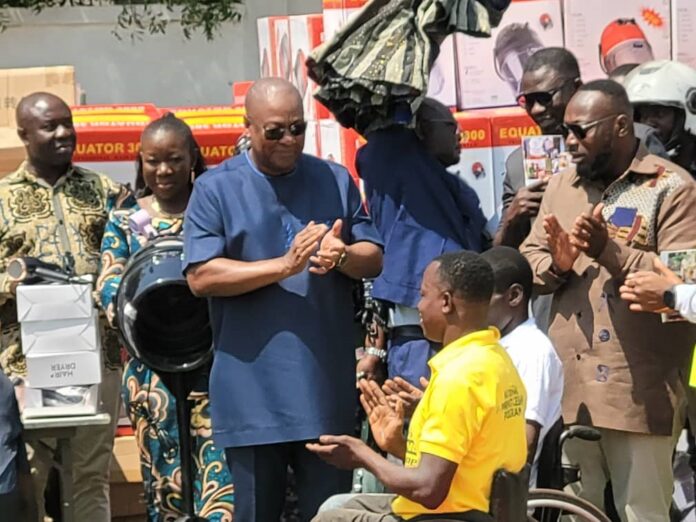
Under the new arrangement, graduates who choose self-employment will receive assistance from government through the relevant ministry, including tricycles equipped with mini generators to enhance mobility and productivity.
President Mahama also directed the 24-Hour Economy Authority to ensure that companies operating under the government’s 24-Hour Economy Programme give priority to graduates of the National Apprenticeship Programme when recruiting workers.
He said government would provide companies with a database of trained apprentices to enable employers to identify skilled workers whose expertise matches their operational needs.
“We are going to tell the 24-Hour Economy Authority that any of the registered companies under the 24-Hour Economy Policy, we will give them the database of our trainees. And if they need any skills, they should prioritise employing trainees from there,” he said.
The President said the move was part of efforts to strengthen the link between technical and vocational education and employment opportunities.
He noted that trained electricians, welders, mechanics, carpenters, dressmakers and other skilled workers would benefit from the policy as government seeks to create sustainable employment pathways.
President Mahama further disclosed that the government’s planned $10 billion economic programme over four years would create additional opportunities for apprenticeship graduates in sectors such as hospitality, tourism, textiles, garments and agro-processing.
He said the textiles and garments sector, in particular, had the potential to absorb many graduates trained in tailoring and dressmaking.
For graduates interested in entrepreneurship, he said they would have access to start-up support and business development assistance through the Adwumawura Programme, while the One Million Coders Programme would provide additional digital skills relevant to their occupations.
He added that women graduates would also benefit from financial support and business assistance, including opportunities through the proposed Women’s Development Bank.
President Mahama revealed that Ghana had received requests from some Caribbean and Middle Eastern countries seeking skilled Ghanaian workers as part of ongoing labour mobility arrangements.
The opportunities, he said, would cover skilled workers such as masons, plumbers, carpenters, steel fabricators and welders.
He explained that the Ministry of Labour, Jobs and Employment would use the apprenticeship database to identify suitable candidates for such opportunities, which are expected to include fixed-term contracts of about five years.
The President announced plans to expand the National Apprenticeship Programme to enrol at least 50,000 young people next year.
He said the pilot phase received more than 300,000 applications despite an initial target of 10,000 participants, resulting in the enrolment of 14,335 apprentices across all 16 regions.
Out of that number, 13,309 successfully completed the programme, comprising 10,325 females and 2,984 males.
President Mahama noted that women accounted for nearly 78 per cent of the graduating class, highlighting the importance of creating more opportunities for women in technical and vocational fields.
He, however, encouraged more young women to enter traditionally male-dominated areas such as welding, electrical installation, plumbing, mechanical engineering and renewable energy.
The President also called for greater inclusion of persons with disabilities, noting that only 112 graduates under the programme were persons living with disabilities, below the five per cent target.
He urged graduates to uphold professionalism, punctuality, honesty and innovation, stressing that the long-term success of the programme would depend on their ability to secure employment, build viable businesses and create jobs for others.
Meanwhile, the Minister for Youth Development and Empowerment, George Opare Addo, has proposed the establishment of a National Apprenticeship Levy to provide sustainable funding for the programme.
Under the proposal, businesses and organisations that rely on skilled labour would contribute annually to a dedicated apprenticeship fund to support skills development.
Companies that directly engage apprentices, provide stipends or offer structured workplace training would, however, be exempt from the levy.
Mr Opare Addo said the proposal was aimed at making skills development a shared responsibility between government and the private sector.
“Ghana cannot build a sustainable national apprenticeship system if its survival depends entirely on government funding,” he said.
He disclosed that 4,057 master craft persons had been trained and accredited, with 2,834 participating in the pilot phase.
The Minister said the Commission for Technical and Vocational Education and Training (CTVET) supported the training and certification of master craft persons to ensure they possessed the required competencies to train apprentices.
He said government’s objective was to transform apprenticeship from a skills acquisition programme into a pathway for employment, entrepreneurship and sustainable income generation.
By Philip Antoh