









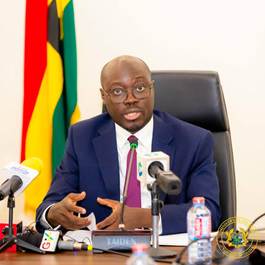

As announced by the Majority Leader and Chairman of Parliament’s Business Committee, James Agalga, Finance Minister Dr. Cassiel Ato Forson is expected to present the 2027 budget to the House on this Thursday November 12, 2026 as mandated under Article 179 of the 1992 Constitution of Ghana. The 2027 budget is titled “The New Economy”.
According to the Ministry of Finance Guidelines, targeted parameters include real GDP growth of 6% or higher, inflation at 7% (±2%), and an overall budget deficit projected between 2.9% and 3.3% of GDP for 2027–2030.
Here are key expectations
1. Fiscal consolidation continues, but at a gentler pace – The 2026 Budget targets a 6.0% of GDP deficit in 2026 (down from a revised ~7.5–8.0% in 2025). The framework signals a 5.0% deficit target for 2027, on a glide path toward 4.0% by 2028.
A primary surplus of ~2.0% of GDP is expected for 2027 (after 1.5% in 2026), consistent with IMF targets.
Debt-to-GDP is projected to fall to roughly 69–70% by end-2026 (from ~83% end-2025), with a medium-term anchor of ≤56% by 2028 — partly helped by currency appreciation.
Growth is projected at ~5.0% in 2027 (vs. 4.9% targeted for 2026), with inflation expected to ease toward ~7%
2. Revenue mobilisation will be the central theme – The tax-to-GDP ratio is targeted to rise from 16.6% (2026) to ~18.0% in 2027 and 20% by 2028 — one of West Africa’s lowest baselines.
Key 2027 levers already announced: digitisation of customs (~GHS 2.0bn expected gain) and legal enforcement of stamp duties on digital contracts (~GHS 1.0bn)
Structural shifts baked in: the E-Levy is repealed (effective Jan 1, 2026) and VAT consolidation to 20% is partly revenue-negative, so 2027 will need new efficiency-driven sources — tax expenditure rationalisation, carbon levy (GHS 5/tonne CO₂) revenues, and mining royalties redirected to the Minerals Income Investment Fund
Expect tension between revenue needs and the 2028 election cycle — analysts flag revenue credibility as the make-or-break issue
3. Spending priorities – Continued funding for the government’s flagship programmes — the 24-Hour Economy, the Big Push infrastructure plan, and the Women’s Development Bank — though independent think tanks (Greats Trust, IMANI) have urged tighter prioritisation and sequencing in the 2027–2028 budgets.
Interest costs remain the biggest pressure point: S&P notes “large and rising interest payments” will keep crowding out development spending.
4. Post-IMF framework – The $3.8bn ECF programme is in its final phase (ends mid-2026), so the 2027 budget will be the first largely under post-programme monitoring. The government is exploring a successor arrangement blending IMF support with a World Bank Development Policy Operation, plus a possible return to sovereign bond markets — 2027 fiscal credibility will be key to that (Reuters).
Investor confidence has improved: S&P upgraded Ghana to B- (positive outlook) in November 2025 — its first upgrade in 15 years — citing sharp debt reduction, but noting fiscal gains must hold through 2026–2027
The bottom line is that expect a modest, credibility-focused budget continued with deficit reduction (to ~5% of GDP), a bigger primary surplus, revenue mobilisation without headline new taxes, and disciplined spending — with the main risks being election-year pressures in 2028, interest costs, and whether growth stays strong enough to keep the debt ratio falling.
What entails in President Mahama’ US$9 billion plan?
Volta Region to benefit most
Based on his announcement at the Hogbetsotso festival in the Volta Region, President John Dramani Mahama’s plans an ambitious US$9.0 billion “New Economy” investment drive. According to sources at the finance ministry the timeline and funding for the $9 billion capital injection is scheduled to be rolled out between 2027 and 2030.
The foundational framework or the blue print for this initiative will be officially be outlined by the finance minister in the upcoming 2027 Budget on Thursday November 12 in parliament.
The Business Mail looks at the headline numbers
Total investment: more than US$9 billion over 2027–2030 (a four-year window).
Annual run-rate: roughly US$2 billion per year, spread across nine “productive pillars.”
Goal: channel public investment into job-rich sectors while keeping fiscal discipline — i.e., without new borrowing, the administration says.
The priority sectors
The plan targets industries chosen for their labour-absorbing capacity: Textiles and garments, Commercial agriculture and agribusiness, Pharmaceuticals, Hospitality and tourism/
A flagship early project: a textile/garment industrial zone on 200 acres acquired in the Keta area, with Ghana Exim Bank commissioned to start work which is expected to create 3,000 jobs initially, rising to ~10,000 when fully operational.
Most of the disclosed detail so far centres on the Volta Region, which Mahama flagged as a major beneficiary.
Coastal protection: GH¢685 million under the WACA (West African Coastal Areas Resilience Investment) project — breakwaters, groynes, revetments, wetland restoration, plus livelihood support for affected communities.
Blekusu Phase 2 coastal protection: additional GH¢250 million.
Keta Port development: 47 initial suitors narrowed to 7 after due diligence; moving into project design and financing.
Eastern Corridor Road: most sections targeted for completion by end-2027.
Volivo Bridge over the Southern Volta River: construction begins Q1 of next year.
Sogakope–Agodome–Tuketa water project: MoU signed with contractor Lesiko in October to resume Phase 1.
District Assemblies Common Fund (DACF): at least 80% to be pushed directly to districts for schools, clinics and feeder roads.
The broader economic logic
Push Ghana toward an investment-grade sovereign credit rating to lower borrowing costs and let local firms raise long-term capital.
Pair the industrial push with household financial security measures.
Build on recent macro wins the administration is claiming — notably FDI jumping from US$624 million in 2024 to US$2.62 billion in 2025.
What’s still missing / being questioned
The Institute for Economic Research and Public Policy (IERPP) has publicly urged the government to publish three things in the budget:
The financing structure (how US$2bn/year is sourced “without new borrowing”).
Bottom line: it’s a four-year, US$9 billion industrialisation-and-jobs programme concentrated on labour-intensive sectors (garments, agribusiness, pharma, tourism), anchored by visible Volta Region infrastructure projects, and billed as fiscally neutral — with the detailed arithmetic still to come in the 2027 Budget this Thursday.