













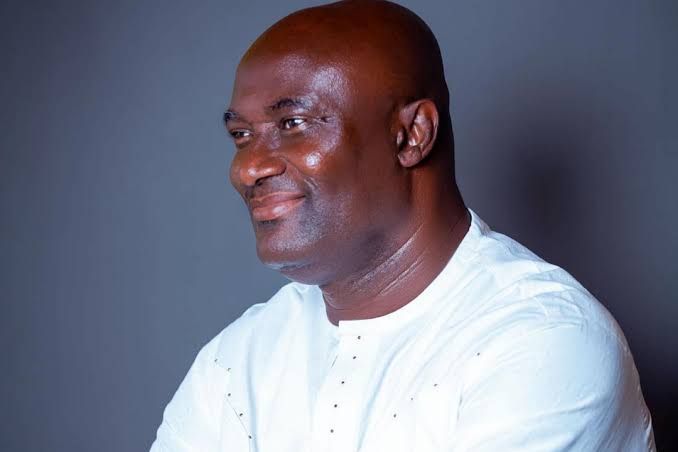

Boateng wants the authorities to examine Chinese-owned malls he says hold about 60 per cent of retail, and a pause before bank repayments begin.
Ghana Union of Traders’ Associations president Clement Boateng says Chinese-owned malls now take about 60 per cent of the retail market, and he wants the authorities to investigate.
He is also asking banks to wait longer before repayments begin. Shipments from the United Arab Emirates that traders expected within 45 to 60 days are taking three to four months, he said, while repayment starts the month after the money is taken.
The 60 per cent is his estimate, given on JoyNews’ PM Express Business Edition on Thursday, November 5.
In August, Ghana Investment Promotion Authority chief executive Simon Madjie told GUTA that open markets, small shops and kiosks are reserved for Ghanaians, while malls and supermarkets may take foreign investment when the investor meets the law.
“These Chinese shopping malls are springing up, and these shopping malls are taking about 60 per cent of our market share, and we think it is having a very negative impact as far as local businesses are concerned,” Boateng said.
He said many of the new outlets are inside the markets. “But if you want to talk about shops springing up, it’s mostly these Chinese shopping malls which are even in the market.”
Where the earnings go
“These Chinese malls will repatriate their profits away. But if businesses, local businesses are doing well, definitely all the monies will remain here,” he said.
He named no mall and no city, and he asked the authorities to examine the malls without proposing a rule.
In August he said: “We are not against foreigners. If you satisfy the law, we have no issue with you.”
Why importers want a pause on loans
“Because you have to reroute as a result of what is happening at the Strait of Hormuz, it now takes quite some time, about three to four months before goods arrive here,” he said.
“And assuming you’ve gone to take a facility from the bank, they will be on your neck because once you take a facility from them, the repayment starts the following month,” he said.
He wants a moratorium, so repayment does not start after one month. “When we take a facility, the repayment shouldn’t start after just one month.”
He said the volume of cargo now arriving is also slowing clearance.
In August, GUTA had separately warned that empty containers were queuing trucks at Tema as far as the Regional Maritime University. He did not tie Thursday’s delay to that queue.
Local goods are still getting dearer
Ghana National Chamber of Commerce and Industry chief executive Mark Badu-Aboagye, on the same programme, said conditions were better than in previous years.
“Relatively, business has been good. Things are a bit better as compared to previous years,” he said.
Tax relief had eased costs for firms and consumers, he said, and interest rates had fallen.
“If you look at the numbers, the cost of locally manufactured goods, the inflation for it went up a bit, which should tell you that we are still not out of the woods yet.”
Inflation was 5.5 per cent in October, up from 5.2 per cent in September, the Ghana Statistical Service said on Wednesday, November 4. It was the third monthly rise in a row, and 2.5 percentage points below the 8 per cent of October 2025.
Locally produced items rose 6.9 per cent over the year, from 6.4 per cent in September. Imported inflation was unchanged at 2.4 per cent.
Local items accounted for 86.4 per cent of the month’s inflation.
“There are outliers. Some may have a higher inflation, even in the regional context,” Badu-Aboagye said.
Further tariff relief, on top of the tax relief already in place, would have lowered the cost of locally made goods. “Inflation would have been a bit lower,” he said.
“If you want to talk about the generality of business in 2026, it is not all that bad,” Boateng said.
Dr Alhassan Iddrisu’s October briefing put Ashanti at 9.7 per cent, Eastern at 7.8 per cent, Ahafo at 6.8 per cent and Central at 6.2 per cent. The Northern Region was 0.5 per cent lower than a year earlier.
3news