













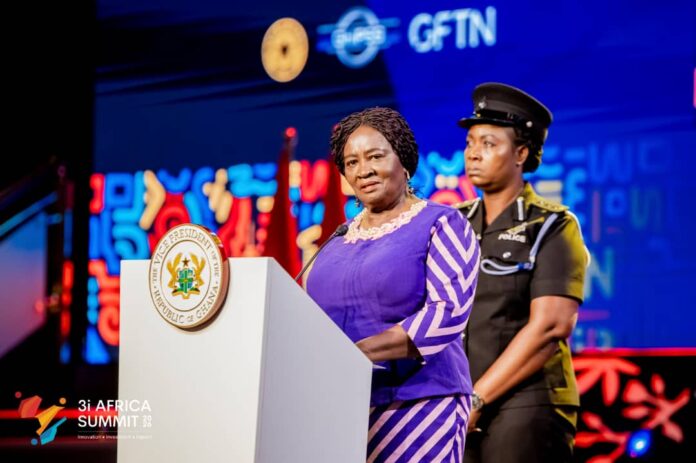

Vice President Jane Naana Opoku-Agyemang has announced that Ghana will spearhead the implementation of a continental digital trade corridor aimed at strengthening Africa’s cross-border commerce and deeper digital integration.
Speaking at the second edition of the 3i Africa Summit in Accra on the theme “The Next Frontier: Shaping Africa’s Integrated Fintech Future”, she said Ghana will pilot the initiative alongside Rwanda, Zambia, and other countries willing to join the framework.
“Ghana will work with Rwanda, Zambia, and other countries to pilot a continental digital trade corridor focused on mobile money interoperability, mutual recognition of digital identity for cross-border Know Your Customer (KYC), and harmonised electronic invoicing,” she announced.
She explained that the initiative is designed to reduce friction in cross-border trade by enabling seamless payments, interoperable digital identity systems, and standardised electronic invoicing across participating countries.
The Vice President stressed that Africa’s next phase of digital growth must be driven by strong political will and coordinated action among governments.
“The systems we build will determine whether Africa participates in the global digital economy on her own terms, or operates within frameworks defined elsewhere,” she cautioned.

She also raised concerns about digital sovereignty, warning that reliance on external data systems undermines Africa’s control over its own digital future.
“If our data is stored and processed elsewhere, then even when we participate, we lack control,” she said.
Calling for a decisive shift toward full digital integration, she said Africa’s competitiveness will depend on its ability to build trusted systems for trade, payments, and digital identity.
She urged the continent to move beyond being described as a “frontier” and instead focus on building scalable systems that ensure certainty and efficiency in economic transactions.
“What matters now is not so much how we are described, but how we organise ourselves to compete, to integrate, and to build at scale,” she said.
The Vice President noted that Africa’s progress in mobile money, digital identity, and financial technology has demonstrated the continent’s ability to leapfrog traditional systems, but warned that fragmented progress is no longer sufficient.
“The task is to move from pockets of progress to continental scale,” she stated.
She outlined four key pillars for Africa’s digital transformation: interoperable payment systems, trusted digital identity frameworks, regulatory alignment, and robust digital infrastructure. She warned that continued reliance on external financial rails and foreign currency settlement systems increases costs and weakens integration efforts.
On digital identity, she said millions of Africans remain excluded from formal systems due to weak identification infrastructure, limiting participation in cross-border trade and digital services.

She also highlighted Africa’s infrastructure gap, particularly in broadband access and data centre capacity, warning that limited local control over data systems poses both economic and sovereignty risks.
In a separate intervention, Governor of the Bank of Ghana, Dr. Johnson Pandit Asiama, called for a shift from expanding access to digital finance toward delivering real economic value at scale.
He said Africa has reached a critical turning point where digital finance must evolve from basic inclusion to deeper financial development that supports businesses, women, youth, and the informal sector.

He noted that while nearly half of adults in Sub-Saharan Africa now have access to digital financial accounts, the next phase must focus on more sophisticated financial services such as digital credit, embedded finance, supply chain financing, and cross-border payments.
“We are now at a point where progress must translate into scale, and access must translate into value,” he said.
Dr. Asiama highlighted persistent challenges including fragmentation, high transaction costs, and uneven regulatory frameworks across countries, stressing the need to connect systems rather than build isolated ones.
He also underscored the importance of balanced regulation that both protects the financial system and enables innovation.
“Regulation and growth are not opposing forces. They must reinforce each other,” he stated.
He outlined ongoing reforms by the Bank of Ghana, including regulations for virtual assets, digital credit guidelines, open banking initiatives, and support for cross-border fintech activity.
Dr. Asiama further stressed the importance of strong digital identity and KYC systems to build trust, reduce fraud, and improve credit quality, while calling for deeper collaboration among regulators, industry players, and development partners.
“Africa has reached a point where participation is no longer the ambition—leadership is,” he concluded.
The 3i Africa Summit is a high-level continental forum focused on advancing Africa’s digital finance and innovation agenda through Innovation, Investment, and Impact.
Jointly organised by the Bank of Ghana and Ghana Interbank Payment and Settlement Systems, with support from partners such as MTN Group and the Global Finance & Technology Network, the summit brings together policymakers, central bank governors, regulators, fintech companies, and development partners.
Held at the Destiny Arena in Accra, the forum serves as a platform to discuss how Africa can strengthen digital payments, financial inclusion, cross-border interoperability, and regulatory harmonisation.
It also focuses on key themes such as mobile money expansion, digital identity systems, fintech innovation, capital investment in digital infrastructure, and the role of technology in supporting the African Continental Free Trade Area.
In essence, the 3i Africa Summit is positioned as a strategic space for shaping Africa’s transition from fragmented financial systems to a fully integrated digital economy that supports trade, innovation, and inclusive growth across the continent.
businessweekghana