













The Commissioner-General of Ghana Revenue Authority (GRA), Anthony Sarpong, has indicated that the nation’s economic sovereignty hinges on its ability to harness digitalization for revenue mobilization.
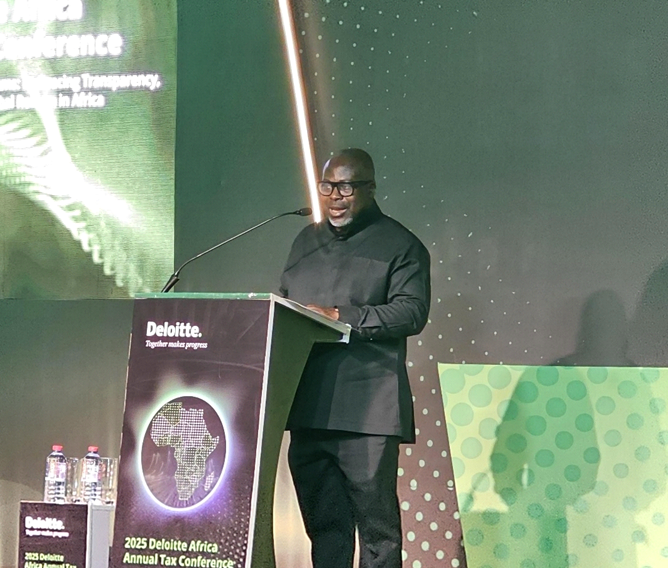
Speaking at the 2025 Deloitte Africa Tax Conference in Accra, Mr. Sarpong said “homegrown revenue mobilization is the way to go for national development” – particularly in light of the steady decline of foreign donor support across the continent.
He noted that this reality calls for innovative approaches to domestic revenue generation, warning that without such measures ongoing fiscal consolidation efforts could be undermined.
“We are piloting a system called Sentinel, which we plan to roll out fully next year to ensure effective taxation of online transactions,” he revealed, adding that the taxpayer of today and the future will be digital. “To this end, we must be prepared to serve that taxpayer efficiently.”
He stated that the electronic VAT system’s rollout is on course. “The journey of VAT digitalisation has started with the E-VAT. At the moment, we have onboarded over 3,000 taxpayers and the journey is continuing.”

According to Mr. Sarpong, GRA is on course to exceed its year-end target of GH¢190billion, having collected GH¢89.45billion by the end of August 2025.
He however acknowledged that the untapped informal sector continues to impact revenue mobilization, saying his outfit is gradually roping the sector into the tax bracket.
“We are operating in an era when fiscal resilience is not just a policy aspiration but a necessity,” Mr. Sarpong asserted.
He confirmed that the informal sector contributes an estimated 30 percent to gross domestic product (GDP) and cannot be kept outside the tax net.
“This means that one-third of potential tax revenue is from that sector. We believe that technology is the way to go in harnessing the potential of this area and bringing everyone into the tax net,” he said.
However, Mr. Sarpong warned that this digital transition must be inclusive. “We must ensure that smaller enterprises, informal sector actors and cross-border traders are not left behind,” he noted.
He noted that this is not a mean feat, calling for partnership to achieve results. “It’s a call for partnership. When we work together, this is where we create a harmony – so that the taxpayer will know what to pay, the GRA will collect their fair taxes and government will also have opportunity to use the revenue for national development.”
The Commissioner-General stated that GRA is focused on “shifting from enforcement to engagement, from compliance monitoring to compliance facilitation”.
He indicated that initiatives like electronic invoicing, real-time data integration and streamlined e-portals are not merely technological upgrades to the country’s tax system but are designed to build what he termed a “culture of voluntary compliance”.
“When all of us contribute our quota, we raise the necessary revenue for national development,” he said.
He further stated that his outfit aims to build a transparent system wherein taxpayers understand their obligations and can meet them efficiently, thereby building trust.
This year’s conference, the first in West Africa, was on the theme ‘Building resilient tax systems: Embracing transparency, digital innovation and global reform in Africa’.
thebftonline