











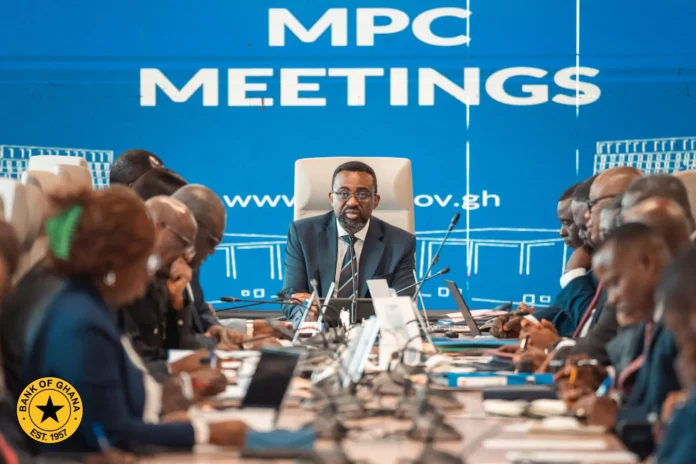

The Bank of Ghana’s 130th Monetary Policy Committee (MPC) meeting begins today, Monday, May 18, 2026, with businesses, investors, banks, and households closely watching.
As the meeting commences today, it could become one of the most consequential policy decisions in recent months.
The three-day meeting, which ends on Wednesday, May 20, comes at a delicate moment for Ghana’s economy. After months of declining inflation, mixed movement in Treasury bill rates, easing lending rates, and relative exchange rate stability, the latest inflation figures showed an unexpected uptick in April.

This raises fresh questions about whether the central bank will continue its monetary policy easing cycle or temporarily pause to reassess risks.
Over the past several MPC meetings, the Bank of Ghana has gradually loosened monetary policy as inflation consistently trended downward from the elevated levels recorded during the peak of the economic crisis. That easing stance helped drive interest rates lower across the economy, reduced government borrowing costs, and provided some relief to businesses and consumers struggling with high financing costs.
But the latest inflation increase has introduced a new layer of uncertainty into the policy conversation. Some analysts believe that the disinflation trajectory has bottomed out, and hence the following month will witness a consistent increase in the rate. This is likely to caution the MPC to be cautious in its decision.
However, for businesses and households yearning for a further drop in lending rates, the stakes are significant. Many companies, especially in manufacturing, trade, and small-scale enterprise sectors, have been hoping for further reductions in the policy rate to ease borrowing costs and improve access to credit.

Lower rates would also support investment expansion and consumption at a time when many firms are still recovering from the economic shocks of the past few years.
The central bank now faces a difficult balancing act. The April inflation uptick could signal that underlying price pressures are not fully defeated. Rising global oil prices linked to geopolitical tensions in the Middle East, potential transport cost increases, and imported inflation risks could all complicate the disinflation process in the months ahead.
Analysts believe the Committee could either announce a smaller rate cut than previously expected or maintain the policy rate unchanged temporarily to avoid reigniting inflationary pressures. A pause, while disappointing to some businesses, may be viewed by the central bank as necessary to preserve recent gains in price stability.
Adding further significance to this week’s meeting is Ghana’s evolving relationship with the International Monetary Fund (IMF). The government is currently finalising the completion of the IMF’s Extended Credit Facility (ECF) programme and transitioning into a Policy Coordination Instrument (PCI) arrangement.
The shift is important because it signals Ghana’s movement from direct financial support toward a framework focused more on policy credibility, fiscal discipline, and economic coordination. In practical terms, it means monetary and fiscal authorities will now be under even greater pressure to sustain macroeconomic stability without relying on large-scale IMF bailout financing.

As a result, the MPC’s decision this week will not only influence inflation and borrowing costs but will also send an important signal to investors, development partners, and financial markets about Ghana’s commitment to maintaining policy discipline in the post-ECF era.
For ordinary Ghanaians, the outcome matters as well. Interest rate decisions affect loan repayments, business expansion, transport costs, household spending, and the overall cost of living. A lower policy rate could eventually translate into cheaper borrowing, while a pause could mean rates remain elevated for longer.
Ultimately, this week’s MPC meeting is shaping up to be more than just another routine policy gathering. It is becoming a test of how the Bank of Ghana intends to navigate the next phase of Ghana’s economic recovery after the bailout program with the IMF.