













Ghana’s crude oil production has declined for six straight years, falling from 71.44 million barrels in 2019 to 37.3 million in 2025, due to ageing fields, low investment, operational challenges, and unpaid debts, severely reducing petroleum revenues and development funding.
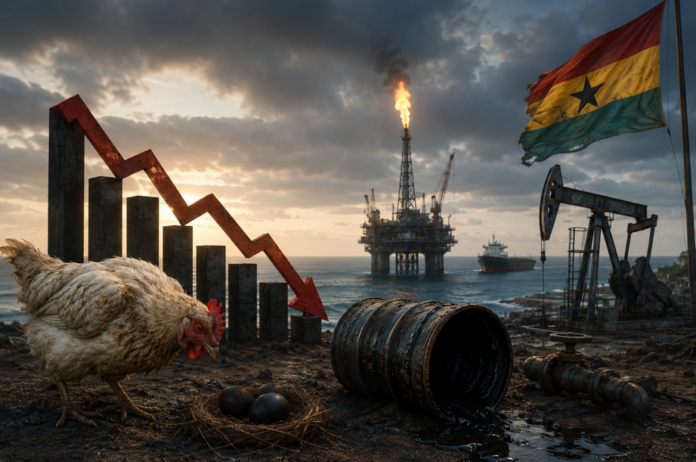
It was all praises and singing when Ghana lifted its first oil production. For many Ghanaians, it was viewed as the ‘golden chickens’ of the economy, expected to lay a steady stream of “black gold eggs” for some time to fund schools, hospitals, and roads.
Although it was not expected that the production would continue in perpetuity, the decline in production has been very sudden and steep.
The Public Interest and Accountability Committee (PIAC) sounded the alarm bells last year over the steep decline in production. Fast forward, the latest 2025 PIAC Annual Report threw more light on the worrying trend that Ghana’s oil chickens are getting tired, and fewer eggs are being collected every year.

The Numbers: A Six-Year Slump
The decline isn’t just a small dip; according to PIAC, it is a sustained downward slide that has lasted for six consecutive years.
The Peak: In 2019, Ghana’s fields produced a record 71.44 million barrels
The Present: By the end of 2025, that number had withered to just 37.3 million barrels
The Rate: This represents a compounded annual average decline of 9 percent
The impact of this declining production has been staggering. In just the last year (2024 to 2025), production plummeted by 22.7 percent, causing total petroleum revenues to crash by over 43 percent, from US$1.36 billion to US$770.27 million
The question many Ghanaians are asking is, “Why are the ‘oil chickens’ no longer laying more eggs?” The High Street Journal has conducted a deep dive into the issues and has found the reasons why production has been declining.
Why are the ‘Chickens’ Not Laying?
According to the PIAC, there are four main reasons why the “taps” are tightening:
- The “Old Age” Factor (Natural Field Depletion)
Just as a chicken produces fewer eggs as it ages, oil fields eventually lose pressure. Ghana’s three main producers, Jubilee, TEN, and Sankofa-Gye Nyame (SGN), are all maturing.
Without new technology or intensive care, these fields naturally produce less oil over time.
- A Lack of “New Chicks” (The Investment Drought)
To keep production high, you need to find new oil to replace what is being used. However, for five consecutive years (2019–2024), Ghana failed to sign a single new Petroleum Agreement
This “investment drought” means no new fields were being readied to take over as the old ones faded.
- Technical “Sickness” (Operational Challenges)
Some fields are facing what can be described as “health issues” deep under the sea. For instance, in the TEN Field, a staggering 81 percent of the gas produced had to be reinjected back into the ground just to keep the oil flowing.
This high reinjection rate is a sign of complex geological struggles that limit how much oil can actually be extracted.
Moreover, planned maintenance shutdowns, like a 15-day break at Jubilee in 2025, further reduced production.
- The “Hungry Chicken” Problem (The Debt Overhang)
It is a no-brainer that you can’t expect a chicken to lay eggs if you don’t feed it. PIAC reveals that there is a debt overhang that is starving the sector of new activity.
The Government currently owes upstream operators like Tullow approximately US$225 million for gas payments and unpaid costs.
This massive debt has strained investor confidence, leading companies to hold back on drilling new wells that could boost production.

Why the Declining Production Matters to You
As seen in the 2025 petroleum revenue report, when oil production drops, the national purse shrinks. This shortfall directly impacts projects like the “Big Push Agenda, which is the government’s ambitious infrastructure plan mainly funded from oil proceeds.
In 2025, while US$434.55 million was set aside for these roads, much of it sat unutilized in accounts while the country waited for feasibility studies.
Even local communities felt the pinch, as the District Assemblies Common Fund (DACF) received only 0.43 percent of its expected oil money, far below the 5 percent required by law.

A Call to Action
As long as Ghana’s crude oil endowment is not totally depleted, there is a need for continuous production.
To get the “oil chickens” laying again, the Committee recommends urgent reforms: boosting investment in existing fields, clearing the debts owed to partners, and aggressively searching for new oil basins before our current reserves run dry.
thehighstreetjournal