











Institute of Economic Affairs and former Chief Justice Sophia Akuffo have joined growing public opposition to Gold Fields’s Tarkwa lease extension, demanding greater Ghanaian ownership of strategic mineral resources.
The growing national conversation around Ghana taking greater control of its natural resources has received a major boost as the Institute of Economic Affairs (IEA) has joined sections of Ghanaians to oppose efforts by Gold Fields to secure another 20-year extension of the Tarkwa Mine lease.
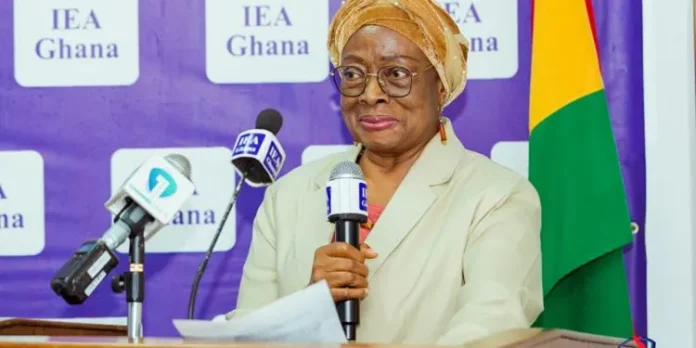
At a press conference in Accra, former Chief Justice and IEA Fellow, Sophia Akuffo, made a strong case for Ghanaian ownership and control of strategic mineral assets, insisting that extending the mining lease would not serve Ghana’s long-term economic interests.
For her, the IEA considers the requested lease renewal or extension deeply inimical to Ghana’s long-term economic and strategic interests.
She is calling on the government to reject the request “decisively” and instead pursue a framework that guarantees meaningful Ghanaian ownership of the Tarkwa Mine.
Her comments come at a time when public resistance against foreign dominance in Ghana’s mining sector is intensifying, particularly after Gold Fields confirmed it is aggressively lobbying the government for a 20-year extension of the Tarkwa lease, which expires in 2027.

Growing Public Sentiment for Ghanaian Ownership
Recent reactions captured by The High Street Journal show a growing wave of frustration among many Ghanaians who believe the country has not benefited enough from decades of foreign-led mining operations.
Many citizens argued that Ghanaian companies and investors should now be given the opportunity to manage strategic mineral resources instead of allowing foreign firms to continue dominating the sector.
Across social media and public discussions, sentiments have centered on the belief that communities hosting mining activities continue to struggle with poor infrastructure, unemployment, environmental degradation, and limited economic transformation despite years of gold extraction.
For many critics, the debate is no longer just about Gold Fields or Tarkwa. It has become part of a broader national push for “resource indigenization”, which is the idea that Ghana must retain greater ownership and control over its natural wealth.
IEA’s Position Reflects Wider National Debate
The IEA’s intervention significantly elevates the debate because it places one of Ghana’s most respected policy institutions firmly behind calls for local participation in strategic sectors.
Justice Sophia Akuffo’s remarks reflect increasing concerns that Ghana risks remaining resource-rich but economically constrained if ownership and decision-making continue to be dominated externally.
Her comments also align with recent policy signals from government indicating a stronger focus on maximizing local benefits from mining operations and tightening conditions around lease renewals.
The debate has gained even more momentum following the government’s earlier refusal to renew Gold Fields’ Damang lease, a move widely interpreted as a sign that authorities are becoming more assertive in redefining Ghana’s relationship with multinational mining firms.

Gold Fields Defends Extension Request
Meanwhile, Gold Fields insists that extending the Tarkwa lease would unlock significant economic benefits for Ghana.
The company’s CEO, Mike Fraser, recently disclosed that the mining giant plans major reinvestment, expansion of equipment, and increased employment if approval is granted for another 20 years of operations.
According to the company, Tarkwa remains one of its most important global assets and continued operations would support jobs, contracts, and local economic activity.
However, critics argue that after decades of extraction, Ghana must now move beyond simply hosting foreign mining companies and instead build stronger local ownership structures capable of retaining more value within the country.

The Bottomline
The Tarkwa lease debate is increasingly shaping up as a major test of Ghana’s evolving resource governance direction.
With the IEA openly backing calls for local ownership, pressure is likely to intensify on the government ahead of any final decision on the Tarkwa lease renewal.
thehighstreetjournal